How to Maintain Rooftop HVAC Without Surprises

A rooftop unit can appear to be working normally right up until a hot office, a cold sales floor, or a production interruption proves otherwise. Learning how to maintain rooftop HVAC equipment gives property owners and facility managers a practical way to protect comfort, control operating costs, and avoid emergency repairs when the weather is least forgiving.

Rooftop HVAC units are exposed to conditions that indoor equipment never sees: wind-driven rain, snow, ice, leaves, pollen, direct sun, and temperature swings. In Northeastern Pennsylvania, winter freeze-thaw cycles and heavy seasonal debris can add another layer of stress. A maintenance plan should account for both the equipment inside the cabinet and the environment around it.

Start With Safe, Regular Rooftop Inspections

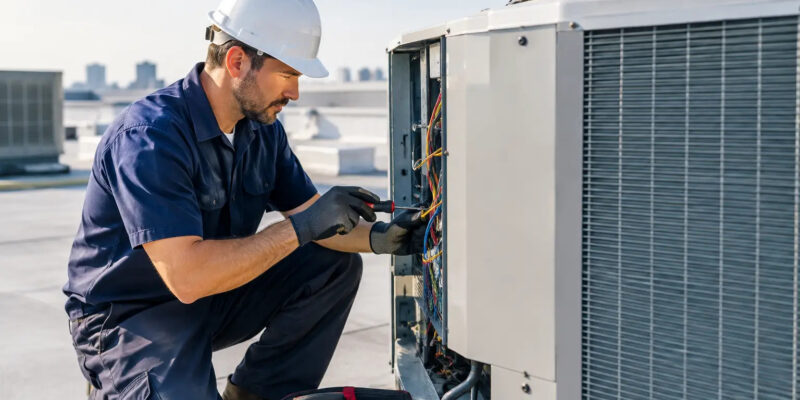
A visual check can catch problems early, but rooftop access is not a casual task. Falls, electrical components, moving parts, and damaged roof surfaces are real hazards. Building staff should only access the roof when they have safe access, appropriate training, and site procedures in place. Never remove electrical panels or reach into a running unit.

From a safe position, look for obvious changes around the equipment. Check whether the unit cabinet is secure, panels are in place, and any visible duct connections appear intact. Notice standing water, loose debris, bent coil fins, damaged insulation, unusual noise, or signs of oil or water around the unit.

Pay close attention after severe weather. A windstorm can deposit branches and trash against the condenser coil. Snow buildup can block outdoor air paths. Ice near a drain outlet may point to a drainage issue that needs attention before it creates leaks or freezes components.

Keep Airflow Clear and Filters on Schedule

Restricted airflow is one of the most common causes of rooftop unit trouble. When filters load up with dust, the blower works harder, heating and cooling capacity drops, and internal components can run at temperatures they were not designed to handle. The result may be uneven temperatures, higher utility bills, frozen evaporator coils, or premature blower and compressor wear.

Filter replacement intervals depend on the building, occupancy, and air quality. An office with typical occupancy may follow a different schedule than a restaurant, warehouse, manufacturing facility, or retail location near a busy road. Rather than replacing filters only when someone notices a comfort complaint, establish an inspection schedule and adjust it based on what the filters actually look like.

The outdoor coil also needs room to breathe. Remove leaves, paper, grass clippings, and other loose material from around the unit. Keep stored materials, pallets, and roof debris away from the cabinet and air intake areas. Do not use a pressure washer on coils, as high pressure can flatten delicate fins and reduce airflow further.

Maintain Drainage Before Water Finds Another Path

During cooling season, a rooftop unit removes moisture from indoor air. That condensate must flow through the drain pan and drain line without obstruction. If the line plugs, water can overflow into the unit, leak onto the roof, damage insulation, or find its way into the building.

A qualified technician should inspect and clear the condensate system during scheduled cooling maintenance. This includes checking the drain pan for corrosion, confirming the trap is properly configured where required, and making sure the drain outlet is open. A recurring drain issue may not be just a clogged line. It can also indicate poor unit leveling, improper piping, microbial buildup, or an airflow problem causing the coil to freeze and thaw excessively.

Roof drains matter, too. They are not part of the HVAC unit, but clogged roof drains can leave water around curbs and penetrations. Keeping the roof area clear helps protect both the equipment and the building envelope.

Schedule Seasonal Professional Service

The best time to service rooftop equipment is before it is carrying the full load of summer cooling or winter heating. For many commercial buildings, that means a cooling inspection in spring and a heating inspection in fall. Facilities with high occupancy, refrigeration needs, critical operations, or year-round cooling may need more frequent visits.

During a professional maintenance visit, a technician can perform work that should not be left to untrained personnel. The scope varies by unit type and condition, but it commonly includes:

  • Checking electrical connections, contactors, capacitors, motors, and control components
  • Measuring operating pressures, temperatures, amperage, and refrigerant performance
  • Cleaning coils with appropriate methods and straightening fins when needed
  • Inspecting belts, bearings, blower assemblies, economizers, dampers, and outside-air controls
  • Testing heating operation, safety controls, ignition components, heat exchangers, and combustion performance where applicable

This testing matters because rooftop units often lose efficiency gradually. A failing capacitor, worn belt, loose electrical connection, or drifting economizer damper may not stop the system immediately. It can still raise energy use and place added strain on more expensive components.

Do Not Overlook the Economizer and Controls

Many rooftop units use an economizer to bring in outdoor air for ventilation and, under the right conditions, provide free cooling. When it works correctly, an economizer can support indoor air quality and reduce mechanical cooling demand. When it sticks open, sticks closed, or loses calibration, it can create comfort complaints that are easy to misdiagnose.

A stuck-open damper can bring in too much cold air during winter or humid air during summer. A stuck-closed damper can reduce ventilation and leave occupants complaining that the space feels stale. Sensors, actuators, linkages, and control settings all deserve attention during maintenance.

Controls should also be reviewed when building hours or space use changes. A rooftop unit serving a former office area may be operating on the wrong schedule after the space becomes a training room, retail floor, or warehouse. Correct scheduling prevents equipment from running unnecessarily while ensuring the building is comfortable when people arrive.

Watch for Signs That Service Cannot Wait

Preventive maintenance reduces surprises, but it does not eliminate every repair. Call for service promptly if the unit short-cycles, trips breakers, makes grinding or banging sounds, produces burning odors, leaks water into the building, or cannot maintain set temperature. Rising energy use without a clear reason is another signal worth investigating.

For gas-fired rooftop equipment, treat combustion-related concerns seriously. Repeated ignition failures, unusual burner operation, soot, exhaust odors, or a carbon monoxide alarm require immediate professional attention. Do not keep resetting the unit in hopes that the problem will clear itself.

It also helps to record recurring issues. Note the date, weather conditions, affected area, thermostat setting, and what employees or tenants observed. Those details help a technician identify intermittent faults faster than a report that simply says the unit is not working.

Plan for Repairs and Replacement With the Whole Building in Mind

Maintenance decisions are not always simple. An older rooftop unit may be repairable, but repeated compressor, heat exchanger, or refrigerant-circuit problems can make replacement the more responsible long-term choice. The right answer depends on repair history, efficiency, parts availability, building use, remaining equipment life, and budget.

Replacement should not be treated as a one-for-one equipment swap without evaluating the system. Proper sizing, curb condition, ductwork, electrical capacity, ventilation needs, controls, and roof access all affect performance. A larger unit is not automatically better. Oversizing can lead to short cycling, poor humidity control, and unnecessary cost.

For properties with several mechanical needs, it is useful to work with a contractor that can see the connections between HVAC operation, plumbing drainage, refrigeration loads, controls, and facility uptime. Hydrodynamics Inc. provides maintenance and repair support for rooftop heating and cooling systems as part of a broader mechanical service approach.

A rooftop unit is easy to ignore because it is out of sight. Put it on a documented maintenance schedule, respond to small changes early, and give qualified technicians the information and access they need to keep the system dependable when your building needs it most.

When Your Business Needs a Commercial Plumber

A restroom that will not drain, a leaking water line above finished space, or a failed sump or grinder pump can interrupt far more than a normal workday. For a business or facility, plumbing trouble can affect employees, customers, inventory, sanitation, and the ability to remain open. A qualified commercial plumber addresses the immediate problem while helping property owners understand what caused it and what is needed to prevent a repeat failure.

Commercial plumbing is not simply residential plumbing on a larger scale. Businesses often have more fixtures, heavier daily use, larger water demands, specialized equipment, and building systems that must work together. The right service approach considers the entire property, not just the visible leak or clogged drain.

What a Commercial Plumber Handles

A commercial plumbing contractor supports the water, drainage, and pumping systems that keep a property functional. The exact scope depends on the building. A small office, restaurant, apartment complex, warehouse, medical facility, and industrial operation each place different demands on their plumbing equipment.

Common service needs include leak repair, fixture replacement, clogged or slow drains, water heater service, water-line installation, backflow-related concerns, restroom upgrades, and drainage repairs. Commercial work may also involve sump pumps, sewage ejector systems, grinder pumps, circulating pumps, utility connections, and equipment serving process or washdown areas.

The visible symptom is not always the full problem. Water staining on a ceiling could point to a failed fitting, a drain issue, condensation from nearby mechanical equipment, or a roof-related concern. Low water pressure can come from a failing pressure tank, a supply restriction, treatment equipment, a pump issue, or aging piping. Proper diagnosis matters because replacing the wrong component only delays the real repair.

For facilities with wells or challenging water conditions, plumbing and water treatment frequently overlap. Hard water can shorten the life of valves, fixtures, water heaters, and other equipment. Sediment can reduce flow and affect pumps. In those cases, solving the issue may require more than a plumbing repair. It may involve water softening, filtration, ultraviolet treatment, or pump-system service.

Signs Your Building Needs Commercial Plumbing Service

Some plumbing failures are obvious. A burst pipe, overflowing fixture, or sewage backup requires prompt attention. Other warning signs are easier to overlook until they become costly disruptions.

Repeated drain clogs in the same area, gurgling fixtures, sewer odors, fluctuating water pressure, unexplained water bills, and damp spots around mechanical rooms all deserve investigation. So do fixtures that run continuously, toilets that frequently need repair, and pumps that cycle more often than usual.

Property managers should also pay attention to patterns. If employees report the same restroom problem every few weeks, a temporary fix may not be enough. If a drain backs up only during busy periods, the line may be undersized, partially obstructed, or affected by the way the space is being used. A careful evaluation can separate a routine service call from a system condition that needs correction.

Water Damage Is Often More Expensive Than the Repair

A small plumbing leak can cause outsized damage when it occurs above offices, retail displays, electrical systems, stored materials, or finished tenant areas. Even after the water source is stopped, wet insulation, drywall, flooring, and concealed framing may require attention.

That is why it makes sense to act when there are early signs of trouble. Repairing a valve, fitting, drain connection, or pump before it fails completely is generally less disruptive than managing emergency service and restoration work after hours. The goal is not to replace equipment prematurely. It is to make decisions based on condition, risk, and the consequences of downtime.

Repair, Replacement, or System Upgrade?

A practical commercial plumber should help you weigh the available options. Repair is often the right choice when a component has a clear, isolated failure and the surrounding system remains in good condition. Replacing a worn flush valve or repairing a localized leak can restore dependable operation without a major project.

Replacement becomes more reasonable when repairs are recurring, parts are no longer readily available, piping is significantly deteriorated, or the equipment no longer matches the building's needs. An older water heater that repeatedly fails during periods of high demand, for example, may cost more in service interruptions than a properly sized replacement.

An upgrade may be needed when the use of the building has changed. A converted retail space, expanded employee area, added commercial kitchen equipment, or renovated tenant suite can alter water and drainage demands. Fixture counts, hot-water capacity, pipe sizing, drainage layout, and pump capacity may need to be reviewed as part of the project.

Cost is naturally part of the decision, but it should not be the only factor. Consider service history, expected remaining life, energy use, available shutdown windows, and the impact a failure would have on operations. For some facilities, planned replacement during a slow period is far preferable to an emergency replacement when the system quits unexpectedly.

Why Plumbing and Mechanical Knowledge Matter

Plumbing equipment rarely operates in isolation. Water heaters may serve restrooms, kitchens, wash areas, or process equipment. Pumps depend on electrical controls and proper piping. A floor drain issue can affect mechanical rooms. Condensate drains from HVAC and refrigeration equipment can create water problems that look like plumbing failures.

Working with a contractor that understands both plumbing and broader mechanical systems can reduce confusion when several systems are involved. Instead of coordinating separate calls for a pump issue, water quality concern, heating equipment connection, and drainage problem, facility decision-makers can get a clearer view of how those systems affect one another.

This is particularly useful for commercial and industrial properties in Northeastern Pennsylvania, where older buildings, rural water sources, basement mechanical rooms, and seasonal temperature changes can add complexity. A frozen or poorly protected line, for example, is not just a plumbing concern. Building insulation, heat distribution, equipment-room conditions, and occupancy patterns may all contribute to the failure.

Preventative Maintenance Protects Operations

Emergency repairs cannot always be avoided, but a maintenance plan can reduce surprises. The appropriate schedule depends on the facility, its operating hours, the age of its equipment, and how critical the plumbing systems are to daily activity.

A restaurant or high-traffic public facility may need more frequent drain and fixture attention than a small professional office. A warehouse with limited plumbing demand may focus on pump testing, water heater checks, freeze protection, and inspections for leaks. Industrial facilities may need specialized maintenance based on their equipment, water use, or process requirements.

Useful maintenance may include checking exposed piping and shutoff valves, inspecting water heaters and relief components, testing pumps and alarms, identifying fixture leaks, monitoring water pressure, reviewing drain performance, and inspecting water-treatment equipment. Maintenance records are valuable because they show repeat failures and help establish whether a repair is holding or a larger correction is needed.

Plan for Access and Shutdowns

Commercial repairs often require coordination as much as technical skill. A repair in a public restroom may need to happen before opening, after closing, or during a lower-traffic period. Work above a production area may require protection for equipment and personnel. Water shutdowns should be planned so affected occupants know what to expect.

Before work begins, ask which areas will be affected, how long the interruption may last, whether temporary service is possible, and whether related equipment should be inspected at the same time. Clear planning helps avoid surprises and can make a necessary repair far less disruptive.

Choosing a Commercial Plumbing Contractor

The lowest initial quote is not always the lowest operating cost. Commercial properties benefit from a contractor that can diagnose the actual issue, explain the repair in plain language, and support the equipment after installation. Experience with pumps, water treatment, heating and cooling equipment, and specialized mechanical systems is also valuable when the problem crosses trade lines.

Look for a contractor that asks useful questions about the building, its use, the age of the system, previous repairs, and the impact of downtime. They should be willing to explain whether a repair is a sensible long-term solution or simply the fastest way to restore service while a larger project is planned.

Since 1994, Hydrodynamics Inc. has helped commercial, industrial, and residential customers address plumbing and mechanical system needs with that broader perspective. Whether the need is an urgent repair, a pump-system concern, a water-quality improvement, or planned equipment replacement, dependable service begins with understanding how the whole system is meant to work.

A plumbing problem does not need to become a building-wide disruption. Addressing warning signs early, maintaining critical equipment, and working with a contractor prepared to look beyond the immediate symptom can help protect your property, your people, and your daily operations.

Rooftop HVAC Hazleton Pennsylvania Service

A rooftop unit can keep an entire building comfortable without taking up valuable indoor floor space – until a failure leaves employees cold, customers uncomfortable, or sensitive inventory exposed to heat. For businesses evaluating rooftop HVAC Hazleton Pennsylvania conditions demand equipment that can handle winter snow, summer humidity, wind, and long operating hours without becoming a constant service concern.

Packaged rooftop HVAC units are common on retail buildings, offices, restaurants, warehouses, schools, and light industrial facilities because they combine heating, cooling, airflow, and controls in one outdoor cabinet. They are practical systems, but they need more than an occasional filter change. Good equipment selection, safe roof access, regular maintenance, and timely repairs all affect how reliably a building operates.

What a Rooftop HVAC Unit Does

A rooftop unit, often called an RTU, is a self-contained heating and cooling system installed on a roof curb. Depending on the application, it may use natural gas, propane, electric heat, a heat pump, or another heating arrangement. The unit draws return air from the building, conditions it, and sends it back through the ductwork.

This design can simplify installation and service for commercial properties. Major equipment stays outdoors, which reduces mechanical-room requirements and can make future replacement less disruptive to the interior. It also allows a property to use separate units for separate zones, such as a sales floor, office area, kitchen, or warehouse.

That convenience comes with a trade-off. Because the equipment sits outside year-round, the cabinet, electrical components, coil, drains, gas connections, economizer, and controls are exposed to weather. Roof leaks around curbs, ice buildup, wind damage, and blocked condensate drainage can become HVAC issues as quickly as a worn blower motor or failed compressor.

Why Local Weather Changes the Maintenance Plan

Northeastern Pennsylvania weather puts rooftop equipment through frequent temperature swings. A unit may run cooling during a warm early fall afternoon and require heat overnight. Winter operation brings snow and ice, while spring and summer add rain, pollen, humidity, and heavy cooling demand.

A preventative maintenance plan should account for those conditions. Before the heating season, a technician should inspect the heat exchanger, burners or electric heat components, ignition sequence, safety controls, blower assembly, belts, bearings, filters, and gas connections where applicable. Before cooling season, attention should shift to refrigerant performance, condenser coils, electrical connections, capacitors, contactors, condensate drainage, and cooling controls.

Snow clearance matters, but it should be handled carefully. Building staff should not strike cabinet panels, refrigerant lines, or electrical components while removing snow. Likewise, a unit should not be surrounded by piled snow, leaves, or debris that restricts airflow. Poor airflow forces equipment to work harder and can lead to high-pressure faults, reduced capacity, and premature component wear.

Signs Your Rooftop Unit Needs Service

A rooftop unit rarely fails without warning, although the warning may be easy to overlook from inside the building. Uneven temperatures, longer run times, unusual cycling, new rattling or squealing noises, and rising utility costs all deserve attention. A unit that trips breakers, blows fuses, leaks water into the building, or produces burning odors needs prompt professional evaluation.

For gas-fired equipment, repeated lockouts or a burner that will not stay lit should never be treated as a minor inconvenience. Heat exchanger and combustion problems require trained service because they involve safety controls, venting, fuel supply, and carbon monoxide risk.

Cooling complaints can be just as disruptive. If the system runs but does not cool adequately, the issue may be a dirty coil, a failing fan motor, a control problem, restricted airflow, refrigerant concerns, or ductwork problems. Replacing a part without identifying the cause can turn one repair into a cycle of repeat service calls.

Property managers should also pay attention to the pattern of complaints. If one area of the building is routinely too hot or too cold while another area is comfortable, the problem may be zoning, thermostat location, dampers, duct leakage, occupancy changes, or equipment sizing rather than a simple mechanical failure.

Repair or Replacement: How to Make the Call

The right answer depends on the unit’s age, condition, repair history, operating cost, and role in the building. A repair often makes sense when the equipment is otherwise sound, parts are available, and the problem is isolated. Replacing a failed contactor, motor, sensor, belt, or capacitor can restore dependable operation without requiring a full system investment.

Replacement deserves serious consideration when a unit has recurring compressor or heat-exchanger issues, requires increasingly costly repairs, cannot maintain comfort during peak weather, or uses equipment that is nearing the end of its practical service life. Energy use also matters. A newer properly sized unit may offer better efficiency, stronger humidity control, improved controls, and fewer emergency interruptions.

Still, the highest-efficiency model is not automatically the best choice. An oversized rooftop unit can short-cycle, struggle with humidity control, and wear components faster. An undersized unit may run continuously and still fail to meet the building load. A proper replacement review should consider square footage, insulation, window area, ceiling height, occupancy, operating hours, internal heat from equipment, ventilation needs, and the condition of existing ductwork.

For facilities with specialized needs, the discussion may also include make-up air, exhaust systems, refrigeration loads, process heat, building automation, or backup heating. Those connected systems affect rooftop unit performance and should be considered before selecting equipment.

The Value of Preventative Maintenance

Preventative maintenance is not simply a checklist completed for records. It is a way to find developing issues before a busy business day becomes an emergency call. Dirty coils, weak electrical components, worn belts, loose wiring, plugged drains, and failing fan motors can often be identified during a planned visit.

A useful maintenance program includes seasonal inspections and documentation of readings, repairs, and recurring concerns. That history helps building owners plan capital expenses instead of making replacement decisions under pressure during a heat wave or cold snap.

Maintenance can also improve day-to-day efficiency. Clean filters and coils support airflow. Correct belt tension protects blower components. Calibrated controls prevent unnecessary run time. Proper combustion and refrigerant checks help the unit deliver the capacity the building expects.

For a property with several units, labeling equipment clearly and keeping service records by unit number makes future troubleshooting faster. It also helps identify whether one specific unit is becoming a disproportionate source of repair costs.

Choosing a Contractor for Rooftop Service

Rooftop work requires more than familiarity with an air conditioner. The contractor must understand heating, cooling, electrical controls, ventilation, safe access, and the building systems connected to the equipment. A commercial facility may also need work coordinated around operating hours, tenants, food service, production schedules, or sensitive inventory.

Ask whether the contractor can inspect the full system rather than addressing only the immediate symptom. Clear communication should include what failed, why it likely failed, what repair is recommended, and whether the condition points to a larger concern. For replacement projects, the scope should address curb compatibility, electrical requirements, duct transitions, controls, crane coordination when needed, startup, and verification after installation.

Hydrodynamics Inc. has served Northeastern Pennsylvania since 1994 with rooftop heating and cooling, commercial HVAC repair, installation, and preventative maintenance. That broader mechanical experience is useful when comfort issues involve more than the rooftop unit itself.

Plan Before the Next Weather Shift

The best time to evaluate rooftop equipment is while it is still operating, not after it stops during the most demanding week of the season. A professional inspection can establish the condition of the unit, identify maintenance needs, and give building decision-makers a clearer path for repair or replacement. That preparation protects comfort, helps control operating costs, and keeps attention where it belongs – on running the business.

Geothermal System Reviews That Tell You More

A geothermal review that says, “My bills went down,” is encouraging. It is not enough to tell you whether a system will work well in your home, on your property, or for your business. The most useful geothermal system reviews explain the starting point: the old equipment, the building’s condition, the loop type, the installation experience, and performance through a full Northeastern Pennsylvania winter.

Geothermal systems can provide dependable heating, cooling, and often domestic hot water by moving heat between the building and the ground. They are efficient, quiet, and built for long service life. They also require more planning than a standard furnace or air conditioner replacement. Reading reviews with the right questions helps property owners separate meaningful experience from general praise.

What Geothermal System Reviews Should Tell You

A good review begins before the new equipment was installed. Look for comments about the customer’s prior system, such as oil heat, propane, electric resistance heat, an aging heat pump, or a furnace and central air setup. Savings and comfort improvements mean different things depending on what the geothermal system replaced.

A homeowner moving from an inefficient oil boiler may see a much different operating-cost change than someone replacing a relatively new high-efficiency natural gas furnace. Likewise, a house that had cold second-floor bedrooms, leaky ductwork, or insufficient insulation may need building improvements along with new HVAC equipment. A geothermal unit cannot correct every comfort issue by itself.

The best reviews also identify the type of project. Was it a new construction installation, a replacement using existing ductwork, a home with radiant heating, or a commercial building with several zones? Those details reveal whether the reviewer’s experience is comparable to yours.

Look for details about comfort, not only utility bills

Energy savings matter, but year-round comfort is often the reason people remain satisfied with geothermal. Useful reviews describe whether the system maintained even temperatures during cold weather, controlled humidity in summer, and operated quietly. They may mention consistent airflow, fewer hot and cold spots, or improved comfort in rooms that were previously difficult to heat.

Be careful with reviews that promise a fixed percentage of savings without context. Electric rates, fuel prices, thermostat settings, occupancy, insulation levels, and weather all affect the result. A contractor should discuss projected operating costs honestly, not present an estimate as a guarantee.

Installation Quality Drives Long-Term Results

Geothermal equipment is only one part of the system. The underground loop field, piping, circulation components, ductwork or hydronic distribution, controls, electrical work, and commissioning all influence performance. That is why installation-focused comments deserve as much attention as brand-focused comments.

Reviews that mention a detailed site visit, load calculation, loop-field planning, clear scheduling, and careful cleanup are usually more valuable than a simple five-star rating. A properly designed system is sized around the building’s heating and cooling load, not selected by square footage alone.

For a closed-loop geothermal system, the contractor may use vertical boreholes, horizontal trenches, or another loop configuration suited to the property. Site access, available land, soil and rock conditions, landscaping, and local permitting can all affect the decision. In the Hazleton area and throughout Northeastern Pennsylvania, varying terrain and lot conditions make property-specific planning especially important.

A review may not use technical terms such as “Manual J load calculation” or “loop design,” but it can still reveal whether the contractor explained the work. Comments like “they answered our questions,” “they walked us through the options,” and “they returned after startup to make adjustments” can indicate a process built around the complete system rather than a quick equipment swap.

Pay attention to how problems were handled

No complex mechanical project is entirely free from surprises. Drilling conditions can change, existing ductwork may need more work than expected, and controls sometimes require adjustment after occupancy. The stronger indicator is how the contractor responds.

Look for reviews that describe communication when a schedule changed, a question arose, or service was needed after installation. A company that provides clear explanations and follows through on corrective work is often a better long-term choice than one with only vague praise about a fast installation.

For commercial and industrial properties, this point is even more significant. Facility managers should look for evidence that a contractor understands access requirements, downtime planning, phased work, equipment coordination, and preventative maintenance. The lowest initial proposal may carry a higher operational cost if it does not account for the building’s actual needs.

How to Read Savings Claims Realistically

Geothermal systems are efficient because the ground temperature is more stable than outdoor air. In heating mode, the system transfers heat from the earth into the building. In cooling mode, it transfers heat from the building back into the ground. This can reduce reliance on delivered fuel and lessen exposure to fuel-price swings.

Still, a review claiming dramatic savings should lead to follow-up questions. Was the old system failing? Did the owner add insulation, replace windows, or change thermostat habits at the same time? Is the review based on one mild winter or several full years of bills? Was supplemental electric heat needed during extreme conditions?

A homeowner considering geothermal should ask for a project-specific operating-cost estimate based on local utility rates and the home’s load. Business owners should also consider demand, operating schedules, ventilation requirements, process loads, and the cost of downtime. Geothermal can be an excellent long-term investment, but the right case is built on measured conditions rather than broad claims.

Maintenance Reviews Matter More Than Many Buyers Expect

Geothermal systems have fewer outdoor exposure concerns than conventional air-source equipment because there is no outdoor condensing unit sitting through snow, ice, leaves, and summer storms. The indoor unit, circulating components, air filter, condensate system, controls, and ductwork or hydronic equipment still need attention.

Strong reviews often mention routine service, responsive repair support, and technicians who can diagnose the full mechanical system. A geothermal unit may be operating correctly while a clogged filter, poorly balanced ductwork, malfunctioning thermostat, or water-flow issue affects comfort. Ongoing service from a contractor familiar with HVAC, plumbing, pumps, and water-related systems can simplify diagnosis when systems overlap.

Before making a decision, ask what maintenance is recommended, what is covered by equipment and labor warranties, and who will provide service after the installation. Geothermal is intended to be a long-term system. The relationship with the installing contractor should be evaluated with the same care as the equipment itself.

Reviews Can Reveal Whether Geothermal Fits Your Property

Geothermal is not automatically the best choice for every building. Upfront installation costs are generally higher than those for conventional HVAC, largely because of loop-field work and system design. A property with limited access, a difficult site, a short ownership horizon, or a building envelope in poor condition may need a different approach first.

On the other hand, geothermal can be particularly compelling for property owners planning to stay put, replacing expensive fuel-based heating, building new, or seeking stable long-term comfort costs. It may also pair well with existing improvements such as upgraded insulation, zoning, duct repairs, or radiant distribution.

When reading reviews, prioritize projects with similar conditions to your own. A review from a rural home with acreage may not translate directly to a compact lot. A new, well-insulated home will not behave like a century-old building with uninsulated walls. The goal is not to find a stranger’s exact savings number. It is to understand whether the contractor evaluated the conditions that will determine your result.

Questions to Ask After Reading Reviews

Reviews should help you prepare for a better contractor conversation. Ask how the heating and cooling load will be calculated, which loop options are practical for the site, and whether your existing ductwork or piping can support the new equipment. Ask how backup heat is handled, what electrical upgrades may be needed, and what the projected installation schedule looks like.

It is also reasonable to ask how the system will be commissioned after installation. Proper startup includes verifying airflow or water flow, refrigerant operation, control settings, and system performance. Those final details help turn a well-designed geothermal project into dependable daily comfort.

For homeowners and facility decision-makers, the most trustworthy geothermal system reviews are not the loudest ones. They are the reviews that describe careful planning, realistic expectations, capable installation, and support that continues after the equipment is running. A geothermal system should be evaluated as a complete property investment, with a contractor ready to stand behind the work for years to come.

Is Propane Heating Right for Your Property?

A cold Northeastern Pennsylvania morning quickly reveals whether a heating system is sized, maintained, and supplied correctly. For properties beyond the reach of natural-gas lines, propane heating can provide reliable, responsive warmth for a home, storefront, apartment building, workshop, or industrial space. The right result, however, depends on more than choosing a fuel. Equipment selection, fuel storage, installation quality, controls, and ongoing service all affect comfort and operating costs.

What Propane Heating Can Do for a Property

Propane is a liquid fuel stored in an outdoor tank and delivered to equipment through properly installed gas piping. It can power furnaces, boilers, unit heaters, fireplaces, space heaters, water heaters, cooking equipment, and certain standby generators. That flexibility is one reason it remains a practical choice for rural homes and facilities with multiple fuel needs.

For a homeowner, propane may support a central furnace and water heater while also supplying a gas range or fireplace. For a commercial or industrial customer, it may serve rooftop equipment, warehouse unit heaters, process-related heating, or a backup application. One fuel source can simplify some aspects of site planning, but the system still needs to be designed around the actual building load and equipment demand.

Propane equipment also delivers heat quickly. A properly operating gas furnace or unit heater produces warm air shortly after ignition, while a propane boiler can provide steady heat to hydronic baseboards, radiators, or in-floor systems. That response can be especially valuable during long cold spells, when buildings need consistent recovery rather than marginal performance.

Choosing Between a Furnace, Boiler, and Other Equipment

The best propane system is not the same for every property. A forced-air furnace is often a sensible choice when ductwork is already present and the building needs central air conditioning as well. The same duct system can distribute heated and cooled air, and filtration options can be incorporated into the overall HVAC design.

A boiler is a strong fit for properties with existing hydronic distribution, including baseboard, radiators, cast-iron systems, or radiant floor heating. Hydronic heat can provide even comfort and may be particularly well suited to homes where preserving the character of an older heating system matters. Boiler performance depends on correct piping, circulator operation, expansion control, venting, and water quality, not just the boiler itself.

For garages, shops, warehouses, and larger open areas, propane unit heaters may be more practical than extending a residential-style central system. These applications require careful consideration of building use, ceiling height, insulation levels, ventilation, and how often large overhead doors are opened. A heater that looks adequate on paper can struggle in a busy loading area or poorly insulated work space.

Some properties benefit from a combination of systems. A heat pump may handle moderate outdoor temperatures efficiently, while propane equipment provides dependable supplemental or backup heat during more severe weather. This type of dual-fuel approach can work well, but it requires properly configured controls so the systems change over at the right time.

Tank Size and Fuel Planning Matter

A propane heating system is only as dependable as its fuel supply. Tank capacity should account for the heating load, equipment connected to the system, delivery access, and the expected winter demand. A property using propane for heat alone has different storage needs than one using it for heat, water heating, cooking, a fireplace, and a generator.

Tank placement is also a practical and safety-focused decision. Required clearances, vehicle access, snow removal, regulator location, protection from damage, and local code requirements all need attention before installation. Underground tanks can preserve the appearance of a property, while above-ground tanks may offer simpler access for service and inspection. The better option depends on the site, budget, and long-term maintenance preferences.

Property owners should also understand their fuel delivery arrangement before the heating season. Automatic delivery can reduce the risk of an unexpected runout, while will-call delivery requires closer monitoring. A runout can shut down heating equipment and may require a qualified technician to inspect and restart the system safely. It is far better to address fuel planning before a winter storm is in the forecast.

Installation Details Affect Safety and Performance

Propane is a dependable fuel when the system is installed and serviced correctly. Safe operation depends on properly sized gas piping, approved shutoff valves, correct regulator settings, sound venting, combustion air, equipment clearances, and leak testing. These are not details to leave to guesswork or a quick equipment swap.

High-efficiency propane furnaces and boilers may use specialized venting materials and condensate drainage. Conventional equipment has different venting requirements. In either case, the venting path must be planned for the specific appliance and building conditions. Improper venting can affect equipment reliability and create serious safety concerns.

Combustion appliances should be paired with working carbon monoxide alarms placed according to manufacturer instructions and applicable requirements. Homeowners and facility managers should also know where the gas shutoff is located and recognize the odor added to propane. If a gas odor is present, leave the area, avoid switches and flames, and contact the propane supplier or emergency services from a safe location.

Maintaining Propane Heating Before It Fails

Preventative maintenance helps identify small problems before they lead to a no-heat call. For a propane furnace, service typically includes inspecting the burner and ignition system, checking heat exchanger condition, confirming gas pressure and combustion performance, testing safety controls, examining venting, and replacing or addressing the air filter as needed. A dirty filter alone can restrict airflow, reduce comfort, and place unnecessary strain on equipment.

Boiler maintenance involves a different set of checks. A technician may inspect burners, safeties, venting, pumps, pressure controls, relief components, piping condition, and system water pressure. Hydronic systems can develop issues such as air in the lines, circulation problems, leaking valves, or uneven heat in certain zones. Addressing those concerns early can protect both comfort and equipment life.

Commercial and industrial properties need maintenance schedules that reflect operating hours and the cost of downtime. A unit heater in a lightly used storage area does not face the same demands as heating equipment in an occupied facility, production space, or business that cannot close during a cold-weather failure. Maintenance planning should match the role the equipment plays in daily operations.

Signs Your System Needs Attention

A propane heating system rarely fails without giving some warning. Uneven room temperatures, delayed ignition, short cycling, unusual burner noise, soot, water around a boiler, rising fuel use, or frequent thermostat adjustments all deserve investigation. These symptoms can stem from something straightforward, such as a filter or thermostat issue, but they can also point to venting, combustion, airflow, circulation, or control problems.

Age is another factor. If repairs are becoming frequent, replacement parts are difficult to source, or the system no longer maintains comfort during cold weather, it may be time to compare repair and replacement options. The best decision depends on the condition of the equipment, expected repair cost, remaining useful life, building plans, and available efficiency improvements. Replacing equipment without evaluating ductwork, piping, controls, and insulation can leave underlying comfort problems unresolved.

A Local Plan for Reliable Winter Heat

For homes and businesses in and around Hazleton, winter heating decisions should account for real conditions: extended cold weather, rural fuel access, older building systems, and the need to keep operations moving. Hydrodynamics Inc. approaches propane equipment as part of the larger mechanical system, considering the heating appliance, distribution system, controls, venting, and service needs together.

Whether a property needs a furnace repair, a boiler replacement, a new propane unit heater, or a maintenance plan, the most useful next step is a clear evaluation of the building and its equipment. A well-planned system does more than produce heat. It gives the people responsible for the property confidence that comfort, safety, and day-to-day operations are supported when winter is at its hardest.