Water Softeners
Hard water affects over 85% of U.S. households, leading to clogged pipes, reduced appliance lifespans, and higher energy costs. A water softener solves this by removing minerals like calcium and magnesium through ion exchange, protecting plumbing, improving water quality, and saving money over time.
Key Takeaways:
- What it does: Replaces hard water minerals with sodium or potassium, preventing scale buildup and improving efficiency.
- Why it matters: Hard water clogs pipes, damages appliances, and requires more soap for cleaning.
- How it works: Uses resin beads to trap minerals, regenerating with a brine solution to stay effective.
- Types available: Salt-based softeners for high hardness, salt-free conditioners for low maintenance, and dual-tank systems for continuous use.
- Costs: Systems range from $1,500 to $4,800 (installation included), with annual salt expenses of $60–$100.
Softened water extends appliance lifespans, reduces energy bills, and enhances everyday tasks like cleaning and bathing. Testing your water’s hardness is the first step to choosing the right system for your home.
Water Softener Buyer’s Guide
sbb-itb-99db659
How Water Softeners Work
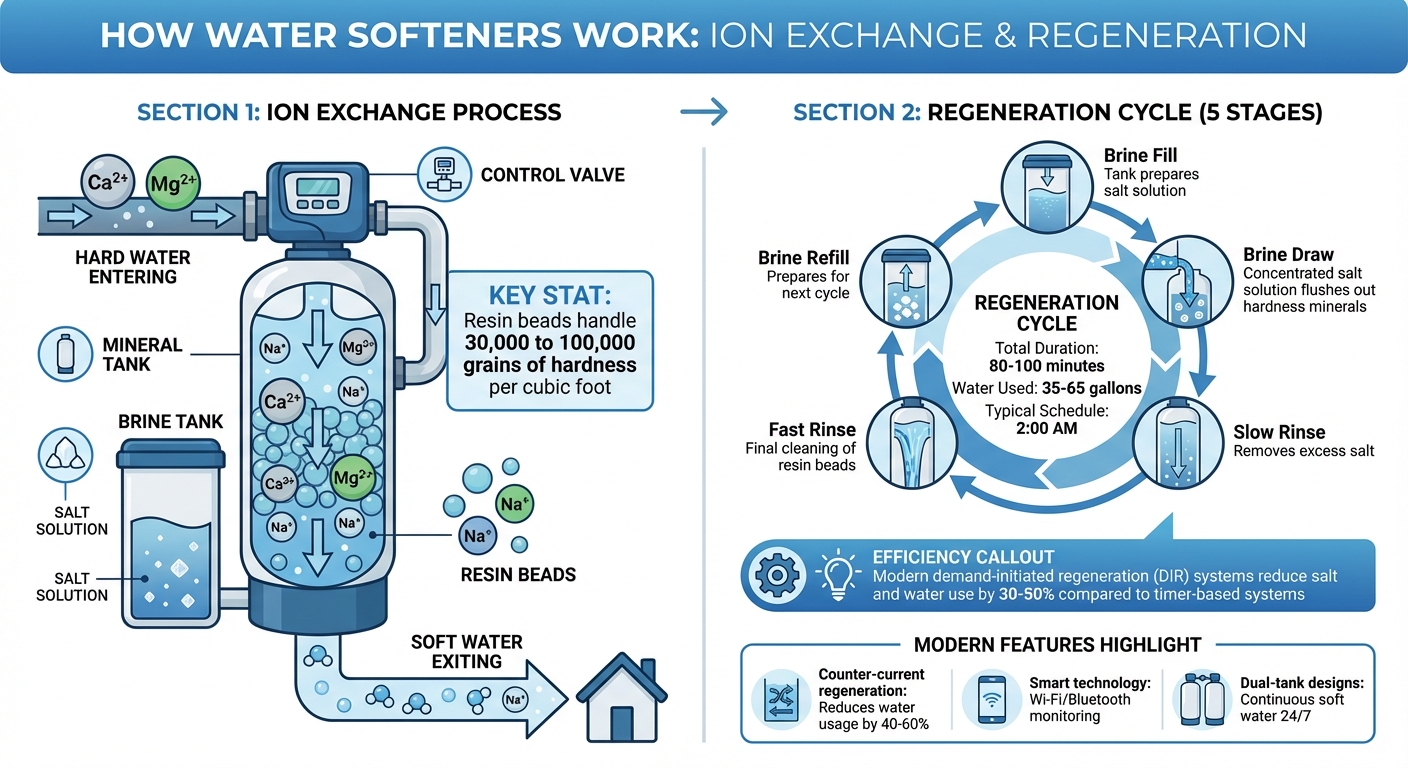
How Water Softeners Work: Ion Exchange and Regeneration Process
The Ion Exchange Process
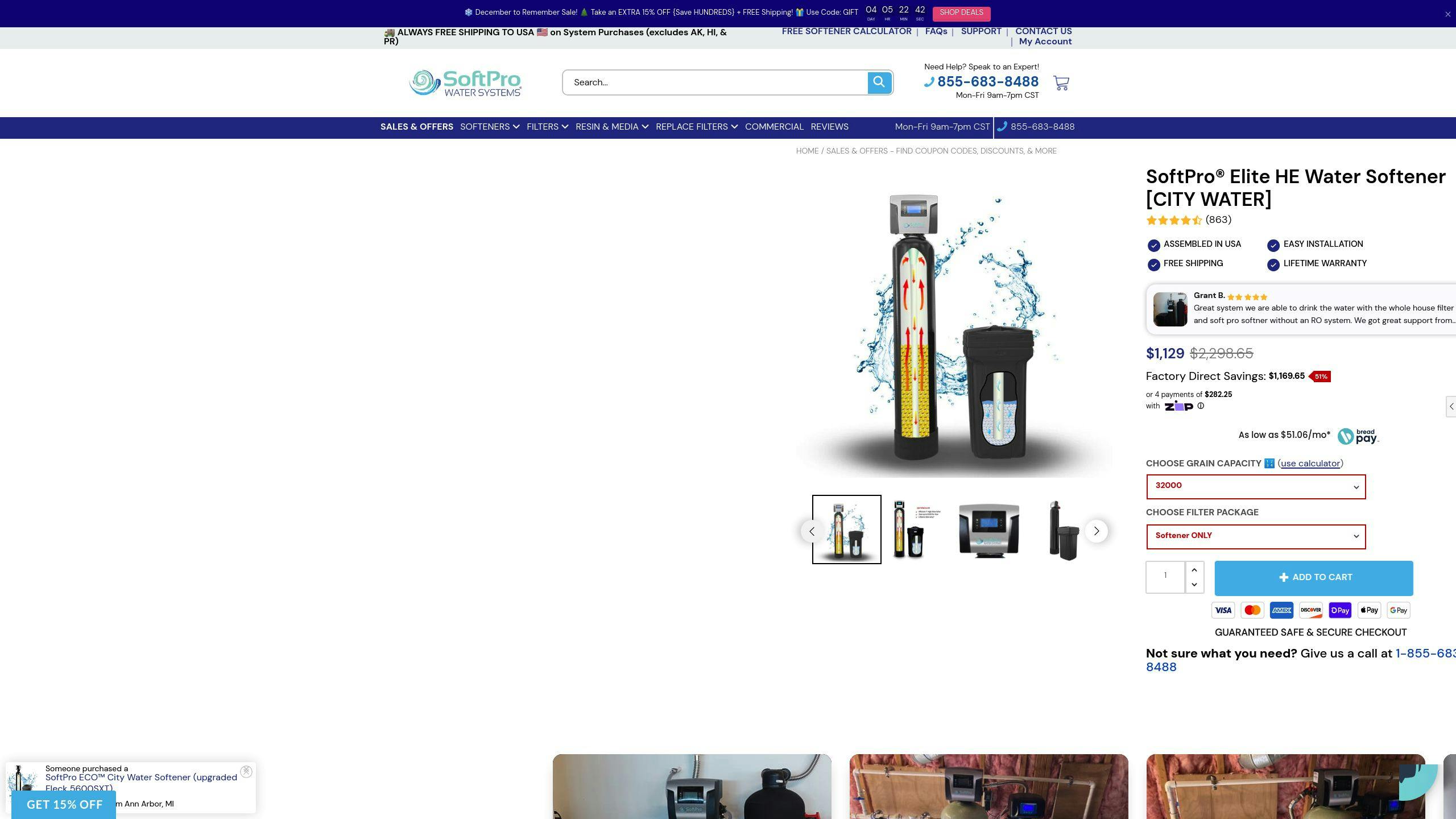
Water softeners rely on a fascinating process called ion exchange. Inside the mineral tank, polystyrene resin beads – charged with sodium or potassium ions – play a key role. As hard water flows through, these beads attract and trap calcium and magnesium ions (the minerals responsible for water hardness), replacing them with sodium ions in the process. The system includes three main parts: the mineral tank (holding the resin), the brine tank (storing salt for regeneration), and the control valve, which regulates water flow and activates the regeneration cycle.
The resin beads are impressively efficient, capable of handling anywhere from 30,000 to 100,000 grains of hardness per cubic foot before needing to recharge. Once the beads reach their limit, the system kicks off a regeneration cycle to restore their softening ability.
The Regeneration Cycle
When the resin beads become saturated with minerals, the regeneration cycle begins. This process flushes out the trapped calcium and magnesium ions and replenishes the beads with fresh sodium ions. To avoid disrupting your water usage, most systems are programmed to regenerate during the early morning hours, typically around 2:00 AM.
A full regeneration cycle takes about 80 to 100 minutes and uses 35 to 65 gallons of water – similar to the amount needed for a single load of laundry. The cycle consists of five key stages: brine fill, brine draw, slow rinse, fast rinse, and brine refill. During the brine draw phase, a concentrated salt solution flushes out the hardness minerals, while the rinsing phases remove excess salt and prepare the resin for continued use.
Modern systems often feature demand-initiated regeneration (DIR), which uses flow meters to monitor water usage and only regenerates when necessary. This approach cuts salt and water use by 30% to 50% compared to older systems that regenerate on a fixed schedule. Thanks to advancements in technology, these systems are now more efficient than ever.
Modern Water Softener Features
Today’s water softeners come packed with features designed to improve efficiency and convenience. Many systems use demand-initiated and counter-current regeneration, which minimizes resource consumption while ensuring uninterrupted service. For example, demand-initiated systems can cut annual salt use from 15–20 bags to under 10 bags. Counter-current regeneration, where brine flows in the opposite direction, reduces water usage during regeneration by 40% to 60%.
Modern units often include smart technology like Bluetooth or Wi-Fi connectivity, giving homeowners real-time access to monitor salt levels, track water usage, and receive maintenance alerts. Advanced control valves with optical sensors and hydraulically-balanced pistons ensure precise operation. Some models even feature dual-tank designs, allowing one tank to stay in service while the other regenerates, so you never run out of soft water.
For homes with well water containing small amounts of iron or chlorine, 10% crosslink resin is a worthwhile upgrade. It lasts 20% to 30% longer than standard 8% resin but comes with a higher price tag. Additionally, many modern systems include power outage protection, with non-volatile memory to retain system settings during electrical failures. These features make today’s water softeners more efficient, durable, and user-friendly than ever before.
Types of Water Softeners
Salt-Based Water Softeners
Salt-based systems rely on ion exchange to remove calcium and magnesium from water, replacing them with sodium ions. This process not only prevents scale buildup but also improves soap lathering. These systems are incredibly effective, achieving up to a 99% removal rate for minerals in very hard water.
“A water softener uses ion exchange to remove calcium and magnesium… It’s the only proven method for truly softening water.” – Aidan, Expert, Mid Atlantic Water
Salt-based water softeners are ideal for water hardness levels above 7.5 grains per gallon (GPG) and are the go-to option if your water contains more than 0.3 mg/L of iron. However, they require regular salt refills, which can cost between $60 and $100 annually. High-efficiency models are designed to minimize salt usage, requiring only 3 to 4 pounds of salt per 1,000 grains of hardness removed. Installation costs for these systems range from $400 to $2,500, depending on size and features.
If you’re looking for a system that doesn’t use salt, a salt-free conditioner might be a better fit.
Salt-Free Water Conditioners
Salt-free systems take a different approach by neutralizing minerals rather than removing them. Using Template Assisted Crystallization (TAC), these systems turn calcium and magnesium into tiny crystals that won’t stick to surfaces, effectively preventing scale formation.
“The battle of hardness removal versus mineral transformation defines the core difference between these competing water solutions.” – Craig “The Water Guy” Phillips, Founder, Quality Water Treatment
These conditioners are best suited for moderate water hardness levels (3.5 to 7 GPG). They require little maintenance – typically just an annual sediment filter replacement – and don’t produce wastewater. However, they don’t technically soften water or improve soap lathering. For individuals on sodium-restricted diets or in areas where salt-based systems are restricted, these systems are an excellent choice. Prices generally range from $500 to $3,000.
For households with high water usage or specific needs, dual-tank systems might be worth considering.
Dual-Tank and High-Capacity Systems
Dual-tank systems are designed for continuous soft water 24/7, thanks to their two mineral tanks and one brine tank setup. While one tank is in use, the other regenerates or remains on standby. This seamless switching ensures uninterrupted access to softened water.
“For households that use water around the clock, businesses, or homes with very high water demand, [dual-tank] is the way to go.” – Aidan, Expert, Mid Atlantic Water
These systems are ideal for large families (5+ people), businesses, or homes with water hardness levels exceeding 25 grains. They can handle flow rates of up to 60 gallons per minute and reduce salt usage by as much as 40% compared to single-tank models. By distributing the workload, dual-tank systems help extend the life of plumbing and minimize maintenance needs. Costs for residential models typically range from $1,000 to $3,500, while commercial-grade systems can exceed $6,000.
Choosing the Right Water Softener
Testing Your Water Hardness
Before buying a water softener, you need to know your water’s hardness level. Hardness is measured in grains per gallon (GPG), where 1 GPG equals 17.1 parts per million (ppm). You can test this with home strips, check your municipal Consumer Confidence Report, or opt for professional lab testing (costing $50–$150) for detailed results on calcium, magnesium, and iron levels.
“Understanding water hardness units is critical for proper system sizing.”
– Craig “The Water Guy” Phillips, Founder, Quality Water Treatment
If your water has iron – common in well water – add 5 GPG for every 1 ppm of iron to your total hardness. Similarly, an acid neutralizer can increase hardness by 4 to 6 GPG. Accurate testing ensures your system is neither overworking nor underperforming. Once you have precise hardness data, you can pick a system with the right capacity.
What to Consider When Buying
To estimate the capacity you need, start by calculating your household’s daily grain demand. Multiply the number of people in your home by 75–80 gallons (the average daily water use per person) and then by your water hardness in GPG. Next, multiply that number by the number of days in your preferred regeneration cycle (usually 5 to 7 days). This will give you the total capacity required.
Flow rate is another key factor. Most homes need systems that handle 8 to 12 gallons per minute (GPM), while larger homes with multiple bathrooms may need 15+ GPM. Look for models with demand-initiated regeneration, which monitor water usage and can cut salt consumption by up to 30%. Also, ensure the system is NSF/ANSI 44 certified and comes with at least a 10-year warranty.
Here’s a quick guide to help you match capacity with your household size and water hardness:
| Household Size | Daily Water Use | Hardness Level | Recommended Capacity |
|---|---|---|---|
| 1–2 People | 75–150 Gallons | 10 GPG | 24,000 – 32,000 Grains |
| 3–4 People | 225–300 Gallons | 10 GPG | 32,000 – 40,000 Grains |
| 5–6 People | 375–450 Gallons | 10 GPG | 48,000 – 64,000 Grains |
Once you’ve determined the right size, weigh the upfront cost against the long-term savings.
Water Softener Costs and Value
By 2026, water softener equipment alone will cost between $700 and $3,500. Professional installation typically adds $500 to $1,200, bringing the total to $1,500–$4,800 for most homeowners. Entry-level systems ($700–$1,200) are suitable for smaller households with moderate hardness, while mid-range systems ($1,200–$2,400) fit average family needs. High-capacity or dual-tank systems start at $2,400 and can exceed $3,500.
“A water softener is the only permanent fix… Prices range from $1,495 to $2,695 for residential systems. That’s far less than replacing a water heater destroyed by scale.”
– Aidan, Water Treatment Expert, Mid Atlantic Water
Investing in the right system protects your appliances and saves money. For example, scale buildup can reduce water heater efficiency by 25% to 48%, while soft water can cut soap and detergent costs by over $200 annually. Maintenance costs are relatively low, with annual salt expenses ranging from $60 to $100. Plus, quality control valves often last 15 to 20 years, and resin beds typically hold up for 10 to 15 years. If you’re using well water, consider 10% crosslink resin, which lasts 20% to 30% longer than standard 8% resin.
Maintaining Your Water Softener
Taking care of your water softener is crucial to keeping your water soft and your plumbing in good shape. Regular maintenance not only ensures your system runs smoothly but also protects your appliances and plumbing from hard water damage.
Adding Salt to the Brine Tank
Check your brine tank’s salt levels at least once a month. Most households need to refill the salt every 4–6 weeks, though some may stretch to 6–8 weeks depending on water usage and hardness. Ideally, the salt level should stay between one-quarter and one-half full, with the salt resting about 3 inches above the water.
For the best results, use evaporated salt pellets. They’re over 99.9% pure and dissolve cleanly, leaving little to no residue. Solar salt crystals, with around 99.6% purity, are another solid option. Stay away from rock salt – it contains impurities that can form sludge and clog your system. On average, a family of four with moderately hard water will go through 40 to 80 pounds of salt per month, costing about $5 to $10.
“Salt is the lifeblood of your water softener – without it, hard water minerals win the battle against your home’s plumbing and appliances.”
– Craig “The Water Guy” Phillips, Founder, Quality Water Treatment
Be sure to check for salt bridges monthly by gently pushing a broom handle into the tank. If you find a hard crust with an empty space underneath, break it up right away to keep the system regenerating properly. Also, avoid overfilling the tank beyond two-thirds full, as this can cause the salt to harden into a thick paste.
Managing salt levels properly is key to keeping your water softener running efficiently.
Cleaning and Inspecting Components
Clean your brine tank once a year with soapy water or vinegar to remove sediment and bacteria. For areas with high iron content in the water, use a resin cleaner like Iron Out every 3–6 months to keep the resin beads working effectively. These beads typically last 10 to 15 years with proper care.
Inspect key parts of your system regularly, including the venturi, bypass, intake, and outtake valves, to ensure there are no blockages. Perform an annual sanitization cycle using a bleach or vinegar solution to prevent bacterial growth.
“A well-maintained water softener provides years of scale-free, spot-free water while protecting your plumbing and appliances.”
– Southern California Well Service
If you notice salty-tasting water, mineral buildup, or soap that doesn’t lather well, it’s a sign your system needs attention. Clean the brine tank, add resin cleaner, and run a manual regeneration cycle to flush out the system.
Using Smart Maintenance Features
Modern water softeners now come with smart features that simplify maintenance. Systems with Wi-Fi connectivity allow you to monitor salt levels, water quality, and performance directly from your smartphone. Real-time alerts can notify you when salt levels are low, water quality changes, or a regeneration cycle is due, making upkeep much easier.
Demand-initiated regeneration (DIR) systems are especially efficient, adjusting to your water usage and cutting salt and water consumption by up to 25% compared to older timer-based models.
“Smart integration maximizes system performance, delivering critical alerts when you need them most.”
– Craig “The Water Guy” Phillips, Founder, Quality Water Treatment
Set up push notifications to ensure your salt levels stay between one-third and one-half full. If you’re heading out of town, activate vacation mode to pause regeneration cycles. This saves both salt and water while extending the life of your resin bed. Many systems also feature digital displays that show remaining capacity, water usage, and diagnostics, helping you catch potential issues early. Make it a habit to review these diagnostics monthly to keep everything running smoothly.
Benefits of Installing a Water Softener
Protecting Plumbing and Appliances
Hard water is a challenge for many U.S. households, and its effects can be costly. Minerals like calcium and magnesium create scale deposits inside pipes, which clog them, reduce heating efficiency by 25–40%, and shorten the lifespan of appliances by 30–50%. This can lead to expensive repairs, such as replacing a water heater (around $1,200) or, in severe cases, re-piping an entire home, which can cost between $5,000 and $15,000.
“It can shorten the life of any appliance that uses hot water.”
– Dave Jones, Master Plumber, Roto-Rooter
A water softener eliminates these minerals through ion exchange, keeping pipes clear, heating elements clean, and appliances running efficiently for years. Beyond extending the life of your home systems, softened water also improves the overall quality of daily water use.
Better Water Quality for Daily Use
Softened water makes a noticeable difference in everyday tasks. Without the mineral residue left by hard water, skin feels smoother, hair becomes more manageable, and laundry comes out softer and brighter with less static cling. You’ll also say goodbye to cloudy film on dishes, stubborn water spots on glassware, and crusty buildup on shower fixtures.
“Hardness can dry out skin, and there’s some evidence that high hardness can be a risk factor in exacerbating eczema.”
– Sam Bear, Senior Research Scientist, Tap Score
From clearer dishes to a more enjoyable shower experience, the benefits of softened water are immediate. These improvements not only enhance daily life but also contribute to long-term savings.
Saving Money Over Time
Investing in a water softener can lead to significant financial savings over time. Hard water can cost a household up to $3,061 annually, while softened water improves energy efficiency by 29%, extends appliance life by 30–50%, and cuts cleaning product expenses in half, potentially saving over $15,600 in ten years. For example, electric water heaters battling scale buildup may use 27% more energy, and avoiding such inefficiency can save approximately $163.20 annually in plumbing maintenance costs. With appliances lasting longer, homeowners could save an additional $3,000 to $5,000 in replacement costs over 10 to 15 years.
While the annual cost of salt for a water softener ranges from $60 to $100, the savings and protection it provides far outweigh this minimal expense.
Conclusion
Hard water impacts more than 85% of U.S. households, leading to problems like scale buildup in water heaters, clogged pipes, and reduced appliance lifespans. Water softeners address this by removing calcium and magnesium through ion exchange, helping to protect plumbing and improve water quality.
To get started, consider testing your water through a professional lab. These tests typically cost between $50 and $150 and can identify hardness levels, pH, and other contaminants. If your water hardness exceeds 7 grains per gallon, treatment is usually recommended.
“I don’t recommend treating your water in an information vacuum.”
– Sam Bear, Senior Research Scientist, Tap Score
Once you have accurate water data, select a water softener that matches your household’s needs. To size it correctly, calculate your daily grain demand by multiplying the number of people in your home by 75 gallons, then multiply that by your water’s hardness level. Choosing the wrong size can result in frequent regeneration cycles or wasted capacity.
Proper installation is equally important. A professional installer can ensure the system is placed correctly, includes an effective bypass for outdoor faucets, and complies with local plumbing codes. Regular maintenance, such as monthly salt checks and annual servicing, can extend the system’s lifespan to 10–15 years. Over time, this investment pays off with lower energy bills, fewer repairs, and longer-lasting appliances.
FAQs
Will softened water raise sodium in my drinking water?
Yes, softened water does add a small amount of sodium – around 7.5 mg per grain of hardness removed. While this is generally minimal, it might be worth noting for those managing sodium intake, such as individuals with hypertension. If you’re concerned about this, one option is to explore alternatives like a reverse osmosis system for your drinking water. Consulting a professional can help you determine the best solution for your needs.
Do I need a separate filter with a water softener?
If you’re wondering whether you need a water filter along with a softener, it often comes down to your water quality. Water softeners handle hardness caused by minerals like calcium and magnesium. However, they don’t tackle contaminants like chlorine, bad odors, or other impurities.
For those issues, a separate filter – like a carbon filter – can be a great solution. Usually, this filter is installed before the softener. Why? It helps protect the softener from harsh chemicals and provides more thorough water treatment for your home.
How do I know my softener is sized correctly for my home?
To determine the right size for your water softener, start by estimating your household’s daily water usage. On average, each person uses about 50 to 100 gallons per day. Next, measure your water hardness level in grains per gallon (gpg) – a key factor in choosing the right system.
Once you have these numbers, match them to the softener’s grain capacity. For smaller households, a system with 24,000 to 32,000 grains should suffice. Larger families, however, might need a unit with 48,000 grains or more to handle the demand.
Don’t forget to think ahead – factor in any possible future changes in water usage. Also, make sure you have enough space for installation to keep the system running smoothly.