
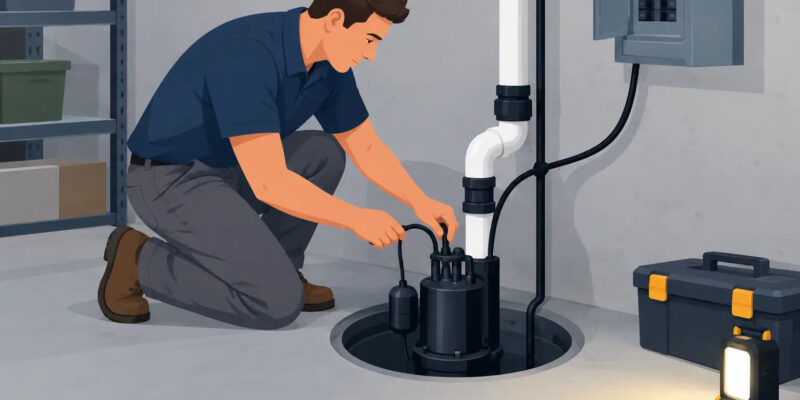
A sump pump can sit quietly for months, then become essential during a heavy Northeastern Pennsylvania rainstorm or rapid snowmelt. If you are searching for how to reset sump pump equipment after an outage or shutdown, start with safety and confirm what caused the pump to stop. A reset may restore operation, but it will not correct a jammed float, failed switch, blocked discharge line, or worn-out pump.
First, determine whether your sump pump needs a reset
Not every sump pump has a dedicated reset button. Many residential pedestal and submersible pumps simply restart when power is restored and the float switch rises. Others stop because the outlet is protected by a ground-fault circuit interrupter, commonly called a GFCI, or because a circuit breaker has tripped.
Before touching the pump, look at the water level in the pit. If water is close to the basement floor or rising quickly, treat the situation as urgent. Avoid standing in water near electrical equipment. If the pump is plugged in but silent, do not reach into the pit or handle the cord until the circuit is turned off at the electrical panel.
A recent power outage is the most common reason for a sump pump to need attention. However, a tripped GFCI or breaker can also signal a real electrical or mechanical problem. Repeatedly resetting a circuit without identifying the cause can create a safety risk and leave the property unprotected when the next storm arrives.
How to reset a sump pump safely
Begin by making sure the pit is accessible and dry around the outlet, plug, and electrical panel. Use a flashlight rather than relying on extension cords or temporary lighting near the basin. If the water level is high, keep hands and tools clear of the water.
Check the GFCI outlet
Many basement sump pump outlets include two small buttons marked TEST and RESET. If the RESET button has popped out, press it firmly until it clicks. Some pumps are protected by a GFCI outlet elsewhere in the basement, garage, utility room, or an adjacent bathroom, so check nearby outlets if the sump pump outlet does not have buttons.
Once the outlet is reset, listen for the pump. A working pump may run immediately if the float is raised by water. If it remains silent, move on to the circuit breaker rather than pressing the GFCI reset button repeatedly.
Reset the circuit breaker correctly
At the electrical panel, look for a breaker in the middle position or marked off. A tripped breaker often does not look fully off. Push it firmly all the way to OFF first, then move it to ON.
Return to the sump pump and check whether power has been restored. If the breaker trips again, leave it off. The pump could have a shorted cord, a seized motor, a defective float switch, water intrusion, or a problem in the circuit itself. That is a situation for qualified service, not repeated resets.
Inspect the pump plug and switch connection
Most standard sump pumps use a piggyback plug arrangement. The float switch plugs into the wall outlet, and the pump plugs into the back of the float switch plug. This allows the float to turn the pump on and off automatically.
With power off, confirm that both plugs are fully connected and that cords are not cracked, pinched, or submerged outside the basin. Do not bypass the float switch by plugging the pump directly into the wall as a permanent fix. That can make the pump run continuously, overheat, or drain the pit below its intended level.
Some sump pumps have a thermal overload protector. When a motor overheats, this protection may shut it down. Depending on the model, it may reset automatically after the motor cools. If a pump stops after running for an extended period, give it time to cool with power disconnected, then restore power and test it. A pump that repeatedly overheats needs professional diagnosis.
Use the pump’s reset button only if the manufacturer provides one
Certain models include a reset button on the motor housing or control box. Consult the pump label or owner’s manual for its location and instructions. With the unit disconnected from power, press the specified reset control, restore power, and test the pump.
Do not confuse a pump reset with a battery backup reset. Backup systems have separate controls, batteries, alarms, and charging components. If the primary pump failed during an outage but the backup did not operate, both systems should be inspected before the next severe-weather event.
Test the sump pump after resetting it
Restoring power is not the same as confirming the system will protect the basement. The most practical test is to slowly pour water into the sump pit until the float rises and activates the pump. Stay nearby and watch the complete cycle.
The pump should start without prolonged humming, move water through the discharge line, and shut off after the water level drops. Check outside, when practical, to verify that water is leaving the discharge pipe and flowing away from the foundation. In freezing weather, an exterior discharge line can become blocked by ice even though the pump itself is running.
A brief hum followed by no water movement may mean the impeller is jammed or the motor has failed. Continuous running can point to a stuck float, a discharge obstruction, or water returning to the pit through a failed check valve. Short cycling may indicate an improperly adjusted float or a pit that is too small for the amount of groundwater entering it.
Do not run a sump pump dry for more than a moment during testing. Most pumps rely on water movement for cooling, and unnecessary dry running shortens motor life.
Problems a reset will not solve
A reset can restore power after a temporary interruption, but it cannot repair worn mechanical components or drainage problems. Arrange service if you notice any of the following conditions:
- The GFCI outlet or breaker trips again after being reset.
- The pump hums, vibrates, or smells hot but does not move water.
- Water rises in the pit and the pump does not start when the float lifts.
- The pump runs continuously or cycles on and off every few seconds.
- Water comes back into the pit after the pump shuts off.
- The discharge line is blocked, frozen, loose, or releasing water close to the foundation.
For commercial properties and facilities, a sump pump failure can affect more than one basement or utility room. Water can interrupt operations, damage stored materials, and create electrical hazards. A service plan that includes routine pump testing, float inspection, discharge-line checks, and backup-system verification is generally less disruptive than responding after flooding begins.
Keep the next reset from becoming an emergency
A sump pump deserves attention before the wet season, not only when an alarm sounds. Test it periodically with water, clear debris from the pit, and make sure the lid is secure if the basin is covered. Check that the discharge pipe directs water well away from the building and that its end is not buried, blocked, or frozen.
If your home depends on a sump pump, consider what happens when utility power is unavailable. A properly maintained battery backup or standby power solution can provide valuable protection, but only if it is sized for the system and tested regularly. The best option depends on how often outages occur, how much groundwater the property handles, and how long the pump may need to run.
When a pump will not reset, trips power, or cannot keep up with incoming water, prompt service protects the building far better than another attempt at the switch. Hydrodynamics Inc. can help homeowners and property managers identify whether the issue is electrical, mechanical, drainage-related, or tied to the pump system itself – and put a dependable repair or replacement plan in place.