
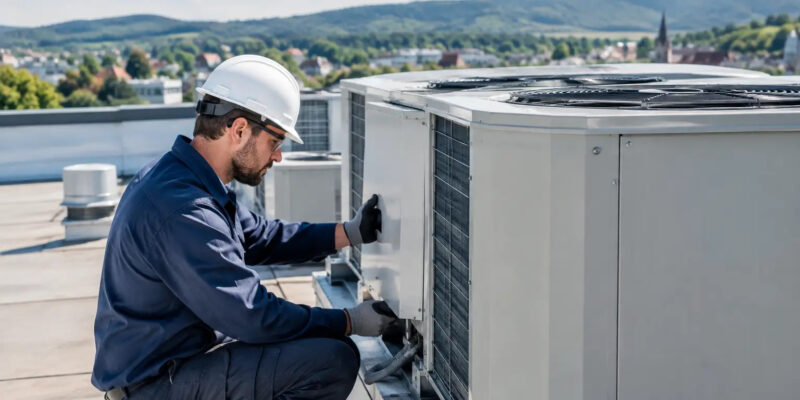
A rooftop unit can keep an entire building comfortable without taking up valuable indoor floor space – until a failure leaves employees cold, customers uncomfortable, or sensitive inventory exposed to heat. For businesses evaluating rooftop HVAC Hazleton Pennsylvania conditions demand equipment that can handle winter snow, summer humidity, wind, and long operating hours without becoming a constant service concern.
Packaged rooftop HVAC units are common on retail buildings, offices, restaurants, warehouses, schools, and light industrial facilities because they combine heating, cooling, airflow, and controls in one outdoor cabinet. They are practical systems, but they need more than an occasional filter change. Good equipment selection, safe roof access, regular maintenance, and timely repairs all affect how reliably a building operates.
What a Rooftop HVAC Unit Does
A rooftop unit, often called an RTU, is a self-contained heating and cooling system installed on a roof curb. Depending on the application, it may use natural gas, propane, electric heat, a heat pump, or another heating arrangement. The unit draws return air from the building, conditions it, and sends it back through the ductwork.
This design can simplify installation and service for commercial properties. Major equipment stays outdoors, which reduces mechanical-room requirements and can make future replacement less disruptive to the interior. It also allows a property to use separate units for separate zones, such as a sales floor, office area, kitchen, or warehouse.
That convenience comes with a trade-off. Because the equipment sits outside year-round, the cabinet, electrical components, coil, drains, gas connections, economizer, and controls are exposed to weather. Roof leaks around curbs, ice buildup, wind damage, and blocked condensate drainage can become HVAC issues as quickly as a worn blower motor or failed compressor.
Why Local Weather Changes the Maintenance Plan
Northeastern Pennsylvania weather puts rooftop equipment through frequent temperature swings. A unit may run cooling during a warm early fall afternoon and require heat overnight. Winter operation brings snow and ice, while spring and summer add rain, pollen, humidity, and heavy cooling demand.
A preventative maintenance plan should account for those conditions. Before the heating season, a technician should inspect the heat exchanger, burners or electric heat components, ignition sequence, safety controls, blower assembly, belts, bearings, filters, and gas connections where applicable. Before cooling season, attention should shift to refrigerant performance, condenser coils, electrical connections, capacitors, contactors, condensate drainage, and cooling controls.
Snow clearance matters, but it should be handled carefully. Building staff should not strike cabinet panels, refrigerant lines, or electrical components while removing snow. Likewise, a unit should not be surrounded by piled snow, leaves, or debris that restricts airflow. Poor airflow forces equipment to work harder and can lead to high-pressure faults, reduced capacity, and premature component wear.
Signs Your Rooftop Unit Needs Service
A rooftop unit rarely fails without warning, although the warning may be easy to overlook from inside the building. Uneven temperatures, longer run times, unusual cycling, new rattling or squealing noises, and rising utility costs all deserve attention. A unit that trips breakers, blows fuses, leaks water into the building, or produces burning odors needs prompt professional evaluation.
For gas-fired equipment, repeated lockouts or a burner that will not stay lit should never be treated as a minor inconvenience. Heat exchanger and combustion problems require trained service because they involve safety controls, venting, fuel supply, and carbon monoxide risk.
Cooling complaints can be just as disruptive. If the system runs but does not cool adequately, the issue may be a dirty coil, a failing fan motor, a control problem, restricted airflow, refrigerant concerns, or ductwork problems. Replacing a part without identifying the cause can turn one repair into a cycle of repeat service calls.
Property managers should also pay attention to the pattern of complaints. If one area of the building is routinely too hot or too cold while another area is comfortable, the problem may be zoning, thermostat location, dampers, duct leakage, occupancy changes, or equipment sizing rather than a simple mechanical failure.
Repair or Replacement: How to Make the Call
The right answer depends on the unit’s age, condition, repair history, operating cost, and role in the building. A repair often makes sense when the equipment is otherwise sound, parts are available, and the problem is isolated. Replacing a failed contactor, motor, sensor, belt, or capacitor can restore dependable operation without requiring a full system investment.
Replacement deserves serious consideration when a unit has recurring compressor or heat-exchanger issues, requires increasingly costly repairs, cannot maintain comfort during peak weather, or uses equipment that is nearing the end of its practical service life. Energy use also matters. A newer properly sized unit may offer better efficiency, stronger humidity control, improved controls, and fewer emergency interruptions.
Still, the highest-efficiency model is not automatically the best choice. An oversized rooftop unit can short-cycle, struggle with humidity control, and wear components faster. An undersized unit may run continuously and still fail to meet the building load. A proper replacement review should consider square footage, insulation, window area, ceiling height, occupancy, operating hours, internal heat from equipment, ventilation needs, and the condition of existing ductwork.
For facilities with specialized needs, the discussion may also include make-up air, exhaust systems, refrigeration loads, process heat, building automation, or backup heating. Those connected systems affect rooftop unit performance and should be considered before selecting equipment.
The Value of Preventative Maintenance
Preventative maintenance is not simply a checklist completed for records. It is a way to find developing issues before a busy business day becomes an emergency call. Dirty coils, weak electrical components, worn belts, loose wiring, plugged drains, and failing fan motors can often be identified during a planned visit.
A useful maintenance program includes seasonal inspections and documentation of readings, repairs, and recurring concerns. That history helps building owners plan capital expenses instead of making replacement decisions under pressure during a heat wave or cold snap.
Maintenance can also improve day-to-day efficiency. Clean filters and coils support airflow. Correct belt tension protects blower components. Calibrated controls prevent unnecessary run time. Proper combustion and refrigerant checks help the unit deliver the capacity the building expects.
For a property with several units, labeling equipment clearly and keeping service records by unit number makes future troubleshooting faster. It also helps identify whether one specific unit is becoming a disproportionate source of repair costs.
Choosing a Contractor for Rooftop Service
Rooftop work requires more than familiarity with an air conditioner. The contractor must understand heating, cooling, electrical controls, ventilation, safe access, and the building systems connected to the equipment. A commercial facility may also need work coordinated around operating hours, tenants, food service, production schedules, or sensitive inventory.
Ask whether the contractor can inspect the full system rather than addressing only the immediate symptom. Clear communication should include what failed, why it likely failed, what repair is recommended, and whether the condition points to a larger concern. For replacement projects, the scope should address curb compatibility, electrical requirements, duct transitions, controls, crane coordination when needed, startup, and verification after installation.
Hydrodynamics Inc. has served Northeastern Pennsylvania since 1994 with rooftop heating and cooling, commercial HVAC repair, installation, and preventative maintenance. That broader mechanical experience is useful when comfort issues involve more than the rooftop unit itself.
Plan Before the Next Weather Shift
The best time to evaluate rooftop equipment is while it is still operating, not after it stops during the most demanding week of the season. A professional inspection can establish the condition of the unit, identify maintenance needs, and give building decision-makers a clearer path for repair or replacement. That preparation protects comfort, helps control operating costs, and keeps attention where it belongs – on running the business.