
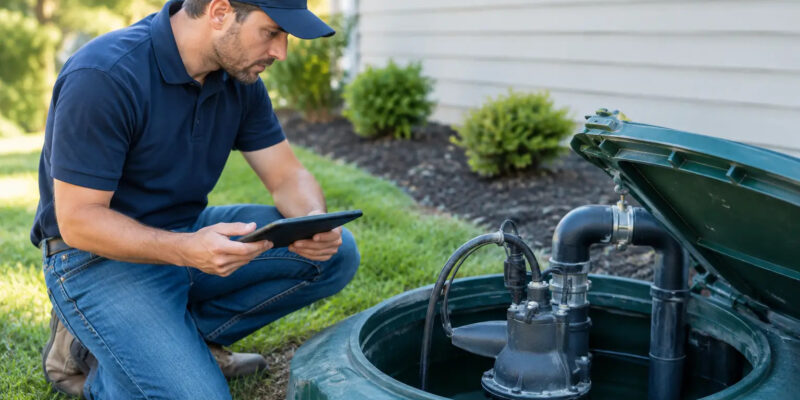
A grinder pump alarm going off during a busy morning is not a nuisance to ignore. It is a warning that wastewater may not be leaving the basin as it should. Knowing the best grinder pump warning signs gives homeowners, property managers, and facility operators time to protect plumbing fixtures, avoid sewage backups, and arrange service before a small issue becomes an emergency.
A grinder pump is designed to grind household or building wastewater solids and pump the waste through a pressurized discharge line to a sewer connection or septic system. Because it handles sewage, the system needs prompt, professional attention when performance changes. The cause may be as simple as a tripped breaker or as involved as a failed pump, stuck float switch, blocked discharge line, or damaged control component.
Best Grinder Pump Warning Signs You Should Not Ignore
The alarm sounds or the alarm light is on
The most obvious warning sign is a high-water alarm. Depending on the system, this may be an audible alarm, a red light, or both. It means the wastewater level in the basin has risen to a point where it needs attention. The pump may not be running, it may be unable to keep up with incoming flow, or the alarm float may be malfunctioning.
An alarm does not always mean the pump has permanently failed, but it does mean the system should be treated carefully until the problem is identified. Reduce water use immediately. Avoid running laundry, dishwashers, showers, and large volumes of water until a qualified technician can inspect the pump system.
Drains become slow throughout the building
One slow sink can be a local drain issue. Several slow drains, toilets that flush poorly, or wastewater backing up at the lowest fixture point to a broader drainage problem. In a home with a grinder pump, this can occur when the basin is full and the pump is not moving wastewater out through the discharge line.
For commercial properties, early symptoms may show up in a restroom, break room, janitorial sink, or floor drain before operations are widely affected. Do not assume repeated plunging will solve the issue. If the pump or discharge system is the source, adding more water to the system can worsen the backup risk.
The pump runs constantly or cycles too often
A properly sized grinder pump should run when the basin reaches its activation level, then shut off after it has discharged the wastewater. If you hear the pump running continuously, cycling on and off repeatedly, or running much longer than normal, arrange an inspection.
Frequent cycling may be caused by a failing float switch, a pump that is losing capacity, a check-valve problem, groundwater entering the basin, or a restriction in the discharge line. Constant operation can overheat the motor and shorten pump life. It also raises energy use and can turn a repairable control issue into a complete pump replacement.
The pump is unusually loud or makes new noises
Grinder pumps are not silent, but owners usually become familiar with their normal operating sound. Grinding, rattling, humming without pumping, screeching, or hard-starting noises deserve attention. A humming motor that does not move water may indicate a seized impeller, obstruction, failed start component, or motor problem.
Noise alone does not identify the failed part. However, it is useful information for a service technician, especially if you can note whether the sound occurs at startup, throughout the pumping cycle, or after the pump should have shut off.
Sewage odors develop near the basin or outside discharge area
Persistent sewage odors are never normal. They may result from a loose or damaged basin cover, failed seal, venting issue, leaking fitting, or wastewater escaping where it should not. Outdoors, wet or unusually green ground near a discharge line or pump station can also suggest a leak.
Odors should not be masked with air fresheners or treated as a seasonal inconvenience. Besides being unpleasant, they can signal a sanitation concern or an issue that allows moisture to damage nearby equipment and structures.
The breaker trips or controls behave inconsistently
A grinder pump relies on electrical controls, floats, and a dedicated power supply. If its breaker trips repeatedly, the alarm panel loses power, a reset is needed more than once, or indicator lights behave unpredictably, stop treating the problem as a simple reset issue.
Repeated breaker trips can point to motor trouble, damaged wiring, moisture in electrical components, or an overloaded circuit. Electrical troubleshooting around a sewage basin should be left to trained service professionals. Never enter, open, or reach into a grinder pump basin to investigate a problem.
What to Do When a Grinder Pump Alarm Activates
The right response can limit damage while help is on the way. First, stop nonessential water use. Every toilet flush, shower, appliance cycle, and faucet adds wastewater to the basin. Second, check only what can be safely observed from outside the equipment: whether the alarm is active, whether the pump has power, and whether a breaker has tripped.
If a breaker has tripped once, it may be reasonable to reset it one time. If it trips again, leave it off and call for service. Repeated resets can damage equipment or create an electrical hazard. Do not bypass an alarm, disconnect safety devices, or continue using water because the alarm stops temporarily.
For a home, a short period of limited water use may prevent a backup while the pump is diagnosed. At a commercial or industrial site, notify staff quickly and limit restroom or process-water use in the affected area. A written response plan is especially valuable where a grinder pump supports multiple tenants, employees, or customers.
Common Causes Behind Grinder Pump Problems
Many grinder pump failures are linked to what enters the wastewater system. Pumps are built for normal toilet waste and wastewater, not for products that do not break down readily. Wipes labeled flushable, paper towels, feminine hygiene products, diapers, dental floss, grease, rags, and plastic items can jam grinding components or contribute to line blockages.
Power outages are another common source of alarms. When electricity is restored, the pump should generally resume operation, but an alarm that remains active may indicate that the basin level is too high or another problem developed at the same time. Heavy rain can also reveal trouble if groundwater is entering a damaged basin or connection.
Age and deferred maintenance matter as well. Float switches, check valves, seals, control panels, and motors all experience wear. Northeastern Pennsylvania properties can also face seasonal conditions that affect exposed piping, electrical connections, and outdoor pump components. The right repair depends on the pump model, its age, the application, and the condition of the basin and discharge line.
Preventing Disruptive Grinder Pump Failures
The most practical prevention step is controlling what goes down drains and toilets. Keep wipes, grease, and non-dissolvable materials out of the system. If a building has employees, tenants, or guests, clear restroom signage can reduce accidental misuse.
Regular pump-system service is also worthwhile, particularly for properties where a grinder pump handles high daily use or supports essential operations. During an inspection, a technician can evaluate pump operation, floats, alarms, controls, connections, and discharge performance. Preventative maintenance cannot eliminate every failure, but it can identify wear before it leads to a sewage backup.
Hydrodynamics Inc. helps property owners throughout Northeastern Pennsylvania diagnose, repair, replace, and maintain grinder pump systems. A service visit should focus on the entire system, not only the pump motor, because the controls, basin, piping, check valve, and electrical supply all affect reliable operation.
When your grinder pump sounds an alarm, runs differently, or causes slow drains, acting early protects more than the equipment. It protects the plumbing system, the building, and the people who depend on it every day.