
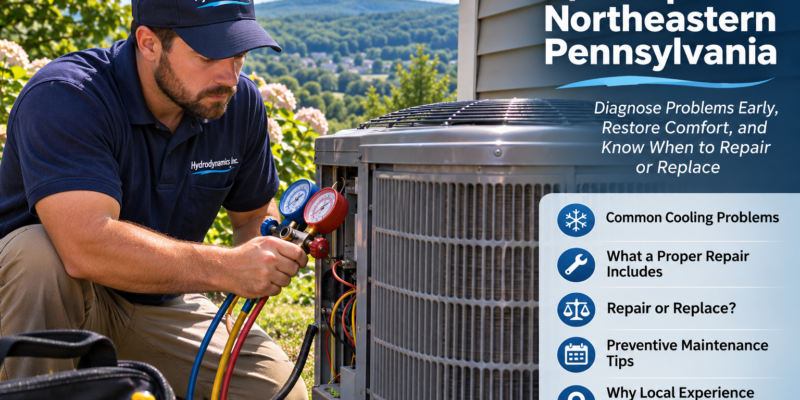
A hot afternoon in Northeastern Pennsylvania can turn a small cooling problem into an urgent one quickly. When your system runs but the house stays warm, cycles constantly, leaks water, or makes a new noise, timely a/c repair can prevent a more expensive failure and restore dependable comfort.
The right response is not always a complete system replacement. Some issues are straightforward: a failed capacitor, clogged drain, worn contactor, dirty coil, refrigerant leak, or airflow restriction can often be diagnosed and corrected without replacing the outdoor unit. Other problems point to an aging system that is costing too much to operate or has reached the point where replacement deserves consideration. A qualified technician should explain the difference clearly, including the condition of the equipment, the repair required, and the likely next steps.
Signs You Should Schedule A/C Repair
Air conditioners rarely fail without giving some warning. Homeowners and facility managers who respond to those warnings early often avoid a no-cooling call during the hottest stretch of the season.
Warm air from the supply registers is the most obvious sign, but it is not the only one. If the system cools unevenly, runs for long periods without reaching the thermostat setting, or turns on and off every few minutes, there may be an issue with airflow, controls, refrigerant charge, or equipment sizing. A thermostat problem can look like an equipment problem, while a dirty filter or blocked return can put unnecessary strain on an otherwise sound system.
Pay attention to changes in sound and moisture as well. Buzzing, humming, grinding, rattling, or repeated clicking may indicate an electrical component, motor, blower, or compressor concern. Water near an indoor air handler may come from a blocked condensate drain or failed condensate pump. Ice on refrigerant lines or the indoor coil is another reason to call for service. Turning the system off can limit further damage, but ice is a symptom, not the cause. Restricted airflow, a dirty coil, a blower issue, or low refrigerant may be behind it.
A sudden increase in electric bills also deserves attention. Cooling costs rise during hot weather, but a sharp change without a matching change in weather or building use can mean the system is running inefficiently. In commercial settings, extended operating hours, occupied areas that do not cool properly, or temperature-sensitive equipment can make that issue more than a comfort concern.
What a Thorough A/C Repair Visit Should Include
A reliable repair starts with diagnosis, not a guess. The technician should consider the whole cooling system: thermostat, indoor air handler or furnace, blower, evaporator coil, outdoor condensing unit, electrical connections, refrigerant circuit, condensate drainage, filters, return air, and supply ducts.
The first step is usually confirming the reported problem and checking basic operation. Is the thermostat calling for cooling? Is the indoor blower operating at the proper speed? Is the outdoor unit receiving power and starting correctly? These questions matter because a system that appears to have a compressor problem could instead have a failed disconnect, capacitor, contactor, control board, or thermostat connection.
Airflow is equally important. A dirty filter may seem minor, but severely restricted airflow can freeze a coil, reduce comfort, and create conditions that damage equipment. Technicians inspect filter condition, blower performance, coil cleanliness, duct restrictions, and return-air capacity. In a home with a finished basement, additions, closed interior doors, or changed room use, airflow concerns may be part of a larger comfort issue rather than a single failed part.
If refrigerant performance is involved, the technician should look for the reason behind the condition. Refrigerant does not get used up under normal operation. Low refrigerant generally indicates a leak that needs to be located and addressed. Simply adding refrigerant without considering leakage may provide temporary cooling but does not solve the underlying problem.
Electrical testing is another essential part of a proper service call. Capacitors, contactors, relays, wiring, breakers, motors, and compressor circuits all work under load. A failing component may operate intermittently before it stops altogether. Finding it early can help avoid being left without cooling when demand is highest.
Repair or Replace? The Answer Depends on More Than Age
Equipment age matters, but it should not be the only factor in a repair-or-replace decision. A well-maintained system may justify a practical repair even after many years of service. On the other hand, a newer unit with a major compressor failure, improper installation, repeated refrigerant leaks, or an undersized duct system may require a broader conversation.
Consider the cost and scope of the repair, the system’s maintenance history, reliability, energy use, refrigerant type, and whether the equipment still meets the needs of the building. If a repair is modest and the rest of the system is in good condition, repair is often the sensible path. If failures are recurring, parts are difficult to obtain, cooling is inconsistent, or the unit is nearing the end of its expected service life, replacement may offer better long-term value.
For homeowners, replacement decisions should also account for comfort. A properly selected central air system, heat pump, or ductless mini-split can improve room-to-room temperature control and may reduce operating costs. For businesses and industrial facilities, the calculation includes downtime, tenant comfort, product protection, ventilation needs, and the consequences of an unexpected outage. Rooftop units, process-related cooling, and larger mechanical systems need planning that goes beyond the price of one repair.
Small Maintenance Tasks That Prevent Major Problems
Property owners can help protect their cooling equipment between professional visits. Replace or clean filters on schedule, following the manufacturer recommendations and the needs of the building. Check that supply registers and return grilles are open and unobstructed. Keep leaves, grass clippings, and stored items away from the outdoor unit so it can move air freely.
Do not hose down electrical components or attempt to open sealed refrigerant systems. Likewise, repeatedly resetting a tripped breaker is not a repair. A breaker that trips again may indicate an electrical or mechanical problem that needs professional attention.
Professional preventative maintenance remains the best way to catch developing problems before cooling demand peaks. A seasonal visit can identify worn electrical parts, drainage issues, coil contamination, airflow concerns, refrigerant performance problems, and loose connections. It also gives owners a clearer picture of equipment condition before an emergency forces a rushed decision.
Why Local Experience Matters for Cooling Service
Northeastern Pennsylvania buildings present a wide range of cooling challenges. Older homes may have limited ductwork or uneven airflow. Rural properties may combine cooling needs with well pumps, water equipment, and other mechanical systems competing for electrical capacity. Commercial properties may depend on rooftop equipment, refrigeration, or multiple zones with different occupancy schedules.
That is why the best service approach looks at how the equipment works within the building, not just at the part that failed. Hydrodynamics Inc. has served the region since 1994 with repair, maintenance, replacement, and installation support for residential, commercial, and industrial mechanical systems. When cooling concerns overlap with electrical demands, drainage, ventilation, plumbing, or specialized equipment, working with an established contractor that understands connected systems can simplify the path forward.
When to Call for Service Right Away
Some cooling concerns should not wait for a convenient appointment. Shut the system down and request service promptly if you smell burning, see smoke, hear loud grinding or banging, find ice on the equipment, notice repeated breaker trips, or have significant water leakage around the indoor unit. These conditions can create further equipment damage and, in some cases, a safety concern.
For less urgent issues, scheduling service while the system still operates is often the most cost-effective choice. A unit that is merely noisy today may stop cooling tomorrow. A drain that is slow today may become a water-damage problem during the next humid week. Early diagnosis provides more options and more time to make a sound decision.
Comfort should not depend on hoping a struggling system makes it through another season. A professional evaluation can identify the source of the problem, outline practical repair options, and help you protect the cooling equipment your home or facility relies on.