
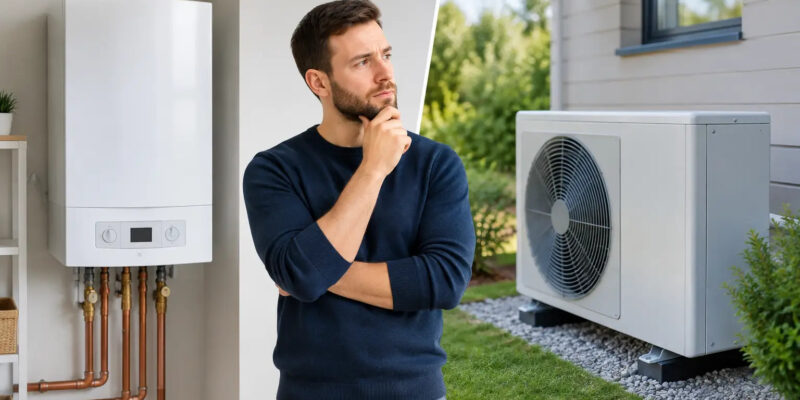
A heating replacement is rarely just an equipment decision. In Northeastern Pennsylvania, it affects how a home feels during a January cold snap, how a business manages utility costs, and how reliably a facility stays open. The boiler vs heat pump question deserves more than a quick comparison of efficiency ratings because the right answer depends on the building, its existing systems, available fuel, and heating priorities.
A boiler remains an excellent fit for many properties, particularly those with hydronic radiators, baseboards, or radiant floor heating. A heat pump can provide highly efficient heating and air conditioning from one system, but it must be properly selected for the building and regional winter conditions. The best choice is the one that delivers dependable comfort without creating unnecessary installation or operating challenges.
Boiler vs Heat Pump: The Core Difference
A boiler heats water and circulates it through pipes to radiators, baseboard units, unit heaters, or radiant-floor tubing. Gas, propane, oil, or electricity can power a boiler, although gas, propane, and oil are common options in this area. The system provides heat only, so cooling requires separate equipment such as central air conditioning, ductless mini-splits, or another cooling system.
A heat pump moves heat rather than creating it through combustion. During winter, it gathers heat from outdoor air and transfers it indoors. In summer, it reverses operation to remove heat from the building, acting like an air conditioner. Air-source heat pumps are the most common type, while geothermal heat pumps use stable underground temperatures and require a more substantial installation.
That difference shapes nearly every part of the decision. Boilers are usually part of a dedicated hydronic heating system. Heat pumps can be ducted, ductless, or paired with existing equipment, offering year-round climate control in one package.
When a Boiler Is the Better Fit
Replacing a boiler with another boiler is often the practical choice when a property already has a sound hydronic distribution system. Existing radiators, baseboard loops, circulator pumps, zone valves, and piping represent a significant investment. Keeping that infrastructure in service can avoid the cost and disruption of installing ductwork or multiple indoor heat-pump heads.
Hydronic heat also has characteristics many property owners prefer. Radiant floors and cast-iron radiators provide steady, quiet warmth without moving large volumes of air. Boilers can serve several zones effectively, which is useful in older homes, multifamily properties, offices, and facilities with different occupancy schedules or temperature needs.
A properly sized high-efficiency boiler can be especially dependable during prolonged low temperatures. This matters for buildings with high heat loss, older construction, large open areas, or processes that require consistent interior conditions. Commercial and industrial facilities may also need hydronic systems for unit heaters, process loads, or domestic hot-water production, making a boiler part of a broader mechanical strategy.
Fuel availability matters, too. A property served by natural gas may have a straightforward path to a high-efficiency gas boiler. Rural locations using propane or oil need a more detailed operating-cost analysis, since local fuel and electric rates can shift the long-term picture.
Boiler considerations before replacing
A boiler is not automatically the lower-cost option. Older systems can waste fuel through poor combustion, oversized equipment, failing controls, uninsulated piping, or neglected maintenance. A replacement should include an evaluation of the entire system, not just the boiler cabinet.
For hydronic systems, that evaluation can include water quality, expansion tanks, air elimination, circulators, zone controls, venting, and the condition of radiators or baseboards. Correcting these issues during replacement helps protect the new equipment and improves comfort throughout the building.
When a Heat Pump Makes More Sense
A heat pump is often compelling for homeowners and businesses that need both heating and cooling, especially where central air is absent, outdated, or expensive to repair. Instead of purchasing a boiler for heat and a separate air-conditioning system for summer, a heat pump can cover both needs.
Modern cold-climate heat pumps perform far better in low temperatures than older models. They can supply useful heat well below freezing, and a properly designed system can handle a substantial share of a building’s winter load. For homes with electric resistance heat, aging oil equipment, or limited access to natural gas, the operating-cost improvement can be meaningful.
Ductless mini-splits are also useful where adding ductwork is impractical. They can condition additions, apartments, offices, server rooms, converted garages, and individual areas with uneven comfort. Ducted heat-pump systems may work well when usable ductwork already exists or can be installed without major reconstruction.
Heat pumps do require thoughtful design. Outdoor units need proper placement, drainage, electrical capacity, and clearance for snow and airflow. Indoor equipment must be sized and located to distribute heat effectively. An oversized system may short cycle, while an undersized system may rely too heavily on backup heat during severe weather.
Cold-weather performance and backup heat
The concern most local property owners raise is simple: Will a heat pump keep up when temperatures drop? The answer depends on the specific equipment, heat-loss calculation, building envelope, and backup plan.
Some cold-climate heat pumps can serve as the primary heating source. Others are best used in a dual-fuel arrangement, where the heat pump handles moderate weather and a gas, propane, or oil furnace or boiler supports the building during the coldest periods. This approach can balance efficiency with dependable capacity.
For a home that already has a boiler, keeping the boiler while adding heat pumps for cooling and shoulder-season heating can be an effective middle path. The heat pump reduces boiler runtime in milder weather, while the boiler remains available for deep-winter heating. It is not the right setup for every property, but it illustrates why a full replacement is not always necessary.
Compare Installation Costs and Operating Costs Carefully
Upfront price matters, but it should not be the only number considered. A straightforward boiler replacement using existing piping may cost less initially than converting a radiator-heated building to a whole-home heat pump system. Conversely, a heat pump may avoid the cost of replacing both a heating system and an aging air conditioner.
Operating costs depend on more than equipment efficiency. Electric rates, gas or propane prices, insulation levels, thermostat settings, occupancy patterns, and maintenance all affect annual expense. A high-efficiency system in a drafty building still has to replace the heat escaping through walls, windows, attics, and air leaks.
A professional load calculation is essential for either option. Square footage alone is not enough. Building orientation, window area, insulation, ceiling height, infiltration, internal equipment loads, and the desired indoor temperature all influence sizing. For commercial properties, operating hours and occupancy changes must also be considered.
Property owners should also ask what work is included beyond the equipment itself. Electrical upgrades, venting, condensate drainage, duct modifications, piping repairs, controls, thermostats, and removal of old equipment can significantly affect the final project scope.
Maintenance and Service Requirements
Both systems need regular attention. Boilers should receive annual service that includes combustion testing where applicable, safety-control checks, inspection of venting and leaks, and review of system pressure and components. Water quality and proper system treatment are particularly important for protecting hydronic equipment.
Heat pumps benefit from seasonal maintenance as well. Technicians should inspect refrigerant performance, electrical connections, coils, filters, condensate drains, defrost operation, and outdoor-unit condition. Keeping snow, leaves, and debris away from the outdoor unit helps maintain airflow and winter performance.
For businesses and facilities, preventative maintenance is often more valuable than waiting for a failure. A heating interruption can affect employees, customers, inventory, plumbing protection, and production. Scheduled service gives technicians an opportunity to spot declining components and control issues before they become an emergency call.
The Right Choice Starts With the Building
There is no universal winner in the boiler vs heat pump decision. A well-maintained hydronic system may point strongly toward a new high-efficiency boiler. A property that needs both heating and cooling, or has expensive electric resistance heat, may be an excellent heat-pump candidate. Many buildings benefit most from a hybrid approach that uses each system where it performs best.
Before committing to a replacement, have the building, existing mechanical equipment, fuel options, and comfort concerns evaluated together. A practical recommendation should account for winter performance, summer cooling, installation conditions, long-term service needs, and the way the property is actually used. That careful planning is what turns a new heating system into dependable comfort for years ahead.