
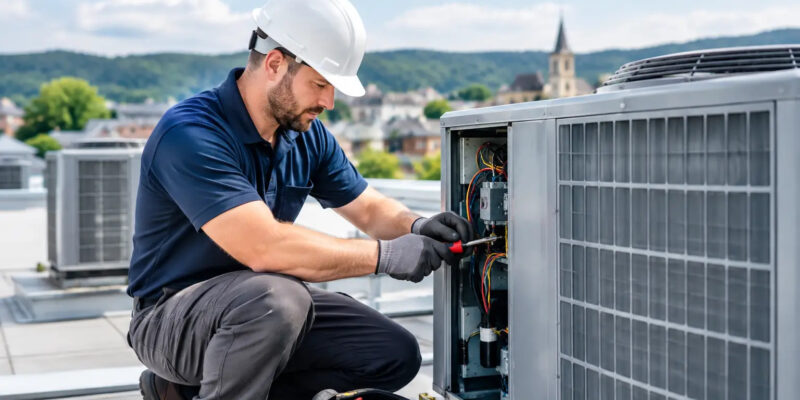
A rooftop unit that quits during a July heat wave can make a retail floor uncomfortable within hours. A boiler issue during a Northeastern Pennsylvania cold snap can stop work, damage inventory, and create an urgent safety concern. Hazleton commercial HVAC maintenance gives business owners and facility managers a practical way to reduce those risks before a minor issue turns into an unexpected shutdown.
Preventive service is not simply changing filters and waiting for the next problem. A useful maintenance plan looks at how equipment is operating under real conditions, identifies developing wear, and helps plan repairs around your business schedule whenever possible. For offices, restaurants, warehouses, medical facilities, apartment buildings, and industrial spaces, that planning can protect both comfort and operations.
Why Commercial HVAC Maintenance Is Different
Commercial heating and cooling equipment often works longer hours and serves more varied spaces than a typical residential system. A single property may have rooftop units, split systems, unit heaters, exhaust fans, make-up air equipment, thermostats, controls, and refrigeration equipment operating at the same time. When one component is not performing correctly, the effect may extend beyond one room.
For example, a blocked condensate drain can cause water damage near an air handler. Poor airflow can force compressors or heat exchangers to work harder. An incorrect control setting may leave one area too warm while another is overcooled. In a facility with production equipment or refrigeration, temperature and ventilation problems can affect product, equipment, and employee working conditions.
That is why commercial maintenance should be based on the equipment installed, its workload, the building’s use, and the season. A light-use professional office will not have the same service needs as a busy kitchen, a manufacturing space, or a building with multiple tenant areas.
What Hazleton Commercial HVAC Maintenance Should Include
A well-managed maintenance visit begins with more than a quick visual inspection. Technicians should review overall system operation and focus on components that commonly contribute to failure, poor efficiency, or uneven comfort.
For cooling equipment, this commonly includes checking refrigerant circuit performance, electrical connections, contactors, capacitors, compressor operation, evaporator and condenser coil condition, blower components, drains, filters, belts, and thermostat or control response. Coil cleaning is particularly important when rooftop equipment is exposed to pollen, dust, leaves, and other outdoor debris. Dirty coils reduce heat transfer and can raise operating costs while placing additional strain on the system.
Heating maintenance depends on the fuel source and equipment type. Gas, propane, oil, heat-pump, geothermal, rooftop, and industrial heating systems each have different service points. A heating inspection may include burner operation, ignition components, heat exchanger condition, combustion-related checks where applicable, venting, safeties, circulation equipment, filters, and control calibration.
The right approach also considers the equipment surrounding the HVAC system. A failing exhaust fan, a plumbing leak near mechanical equipment, or an electrical issue can create symptoms that look like an HVAC failure. A contractor with broad mechanical experience can help identify where the issue actually starts instead of treating only the visible symptom.
Filters Matter, but So Does Airflow
Filter replacement is one of the most recognizable maintenance tasks, but it should not be the only one. Using the wrong filter type or allowing filters to remain in place too long can restrict airflow. Restricted airflow can lead to hot and cold spots, reduced capacity, frozen cooling coils, and unnecessary wear on motors and compressors.
At the same time, selecting a highly restrictive filter without confirming that the system can handle it may create its own problems. The best filter choice depends on the system design, indoor air quality goals, occupancy, and facility activity. A busy workshop, commercial kitchen, or building with frequent deliveries may require more frequent filter attention than a low-traffic office.
Controls Deserve Attention
Many comfort complaints are caused by controls rather than major equipment failure. Thermostats, sensors, schedules, economizer settings, and zoning controls need periodic verification. If a building is heated or cooled during unoccupied hours, or if occupants constantly override thermostat settings, energy costs can climb without anyone noticing the underlying cause.
Controls should be adjusted around the way the facility is actually used. A warehouse with early receiving hours, for instance, may need a different schedule than an office that opens at eight. The goal is not to run equipment as little as possible. It is to run it deliberately, with reliable comfort where and when it is needed.
The Business Value of Planned Service
The strongest reason to maintain commercial HVAC equipment is to reduce disruption. Emergency repairs cannot always be avoided. Motors fail, electrical parts wear out, and older equipment eventually reaches the point where replacement is the more sensible option. But regular inspections improve the chances of finding a loose belt, weak capacitor, failing contactor, dirty coil, refrigerant concern, or drain issue before it creates a no-heat or no-cooling call.
Maintenance can also support clearer budgeting. When a technician documents equipment condition and identifies repairs early, a manager has time to compare options and schedule work during slower periods. That is a much better position than having to make a major decision while employees, tenants, or customers are uncomfortable.
Energy performance is another consideration. Commercial systems do not need to be completely broken to waste energy. Dirt buildup, airflow restrictions, incorrect refrigerant charge, worn belts, and control problems can all make equipment work harder than necessary. The exact savings from maintenance vary by building and equipment condition, so promises of a fixed percentage should be treated carefully. Still, equipment operating as intended is generally easier to manage and less likely to consume energy unnecessarily.
Timing Service Around the Seasons
In the Hazleton area, commercial equipment must be ready for significant seasonal swings. Cooling service is best addressed before sustained warm weather places rooftop units and air conditioners under heavy demand. Heating service should happen before the first extended cold periods, especially for facilities that depend on boilers, unit heaters, rooftop heat, or specialized industrial equipment.
Twice-yearly visits are a sound starting point for many commercial properties: one focused on cooling before summer and another focused on heating before winter. However, higher-demand equipment may need more frequent attention. Restaurants, facilities with refrigeration, industrial operations, high-occupancy buildings, and properties with difficult operating conditions often benefit from a more customized schedule.
Between visits, facility staff can help by paying attention to recurring comfort complaints, unusual sounds, water near equipment, frequent thermostat adjustments, odors, short cycling, and rising utility usage. These signs do not always indicate a major failure, but reporting them early gives a technician more information to work with.
When Maintenance Should Lead to Replacement Planning
A maintenance plan should not be used to keep failing equipment running indefinitely. Older systems may have repeated compressor or heat exchanger issues, use outdated refrigerants, require increasingly expensive repairs, or no longer provide dependable capacity. In those cases, continued repair may cost more over time than planning a replacement.
The decision depends on the age of the equipment, repair history, availability of replacement parts, energy performance, and how critical the system is to your operation. A unit serving a small storage area may be handled differently than the only heating system for an occupied facility. A qualified contractor should explain the condition of the equipment plainly, present practical options, and help you understand what can be scheduled versus what needs immediate attention.
Hydrodynamics Inc. has served local commercial and industrial customers since 1994 with maintenance, repairs, replacements, and integrated mechanical support. That breadth matters when a building issue involves heating, cooling, plumbing, pumps, or specialized equipment rather than one isolated component.
A dependable maintenance relationship gives your facility a record of what has been inspected, repaired, and recommended. More importantly, it gives you a better opportunity to address problems on your terms – before a busy workday, a severe weather event, or a customer complaint forces the issue.