
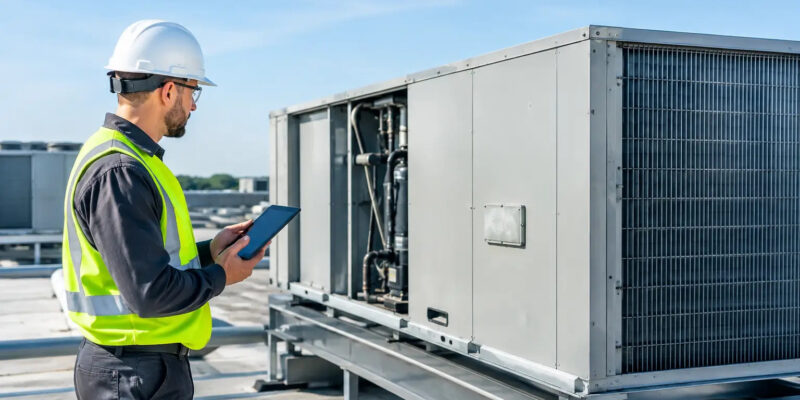
A rooftop unit can appear to be doing its job right up until a tenant complains about a hot office, a dining area will not cool down, or a production space loses heat during a cold Northeastern Pennsylvania morning. For property owners and facility managers, deciding when to replace commercial rooftop units is rarely about one bad service call. It is about understanding whether the equipment can still support the building reliably, efficiently, and safely.
A repair may be the sensible choice for a relatively young unit with an isolated problem. But repeated breakdowns, rising operating costs, aging components, and an inability to maintain comfort can signal that replacement is the more responsible long-term decision. The right timing protects the budget, reduces disruption, and gives the project team time to select equipment that fits the building instead of rushing through an emergency replacement.
When to Replace Commercial Rooftop Units
Most commercial rooftop units have an expected service life of roughly 15 to 20 years. Actual life varies considerably. A unit serving a lightly used office with consistent maintenance may last longer than one operating long hours in a restaurant, retail space, warehouse, or industrial setting. Local weather, installation quality, airflow conditions, maintenance history, and the unit’s original sizing all affect the outcome.
Age alone should not force replacement. A 16-year-old unit that has been maintained well and needs a modest repair may still have useful service life. On the other hand, a 10-year-old unit with chronic compressor issues, coil deterioration, and poor temperature control deserves closer evaluation. The question is not simply, “How old is it?” It is, “What level of reliability and cost can we reasonably expect from it over the next few years?”
Replacement becomes more likely when repairs are frequent, major components are failing, or the unit no longer meets the building’s comfort needs. Planning ahead also matters. Replacing a unit during a scheduled renovation, a shoulder season, or a planned roof project is generally easier than arranging crane access and equipment changeout after a midwinter heating failure.
Signs Repair Is No Longer the Best Value
A single repair does not mean a rooftop unit is finished. Contactors, capacitors, belts, motors, sensors, and certain control components can often be replaced cost-effectively. The concern begins when repairs become repetitive or when expensive core components fail.
Compressor failure is one of the clearest examples. Replacing a compressor can make sense if the unit is otherwise in good condition and the underlying cause has been identified. On an older unit with refrigerant leaks, electrical wear, corroded coils, and a history of service issues, investing heavily in a compressor may only postpone a larger problem.
Watch for these patterns:
- Service calls are becoming more frequent, especially during peak heating or cooling weather.
- Repair costs are increasing or involve major components such as compressors, heat exchangers, evaporator coils, condenser coils, or control boards.
- The unit uses an older refrigerant that is becoming more difficult or expensive to source.
- Occupants report recurring hot and cold spots, humidity problems, unusual noise, or weak airflow.
- Utility costs rise even when the building’s hours, occupancy, and operations have not changed significantly.
- The unit requires temporary fixes to remain operational or cannot hold a consistent setpoint.
The cost of a repair should be considered alongside the cost of another disruption. For a commercial property, downtime may affect employees, customers, inventory, equipment, or lease obligations. A repair that looks less expensive on paper can become costly if the unit fails again during the busiest part of the season.
The Repair-versus-Replacement Calculation
There is no universal dollar threshold that automatically requires replacement. A useful evaluation considers the repair cost, equipment age, condition of related components, operating efficiency, and expected remaining life. If a major repair approaches a meaningful share of replacement cost on a unit near the end of its service life, replacement often deserves serious consideration.
It also helps to evaluate the entire system rather than the immediate failed part. A rooftop unit depends on sound ductwork, correct airflow, dependable controls, electrical capacity, roof curb condition, and proper drainage. Installing a new unit without addressing a damaged curb, undersized return air path, or persistent duct leakage can limit the value of the investment.
Comfort and Capacity Problems Can Point to Replacement
A commercial rooftop unit should do more than turn on and off. It should provide stable temperatures, appropriate airflow, and reasonable humidity control for the way the space is used. If employees regularly use space heaters in winter, customers complain about warm sales areas, or a server room cannot stay cool, the issue may be more than a worn component.
Building use often changes over time. A former office may become a medical practice, retail area, fitness space, or mixed-use facility. A warehouse may add staff, equipment, or heat-producing processes. These changes can alter heating and cooling loads enough that the original rooftop equipment no longer fits the job.
Before selecting replacement equipment, a qualified contractor should review the building’s current use, occupancy, operating hours, ventilation needs, duct layout, and controls. Simply replacing an old unit with the same capacity can be appropriate in some cases, but it should be confirmed rather than assumed. Oversizing can cause short cycling and humidity issues, while undersizing can leave the building uncomfortable during weather extremes.
Efficiency Matters, but It Is Not the Only Reason to Replace
New commercial rooftop units can offer meaningful efficiency improvements over older equipment. Higher-efficiency compressors and motors, improved heat exchangers, modern economizer options, and more capable controls may reduce energy use while improving comfort. For properties with long operating hours, those savings can be a major part of the replacement decision.
Still, efficiency claims should be tied to the property itself. Energy savings depend on utility rates, run time, equipment sizing, maintenance practices, insulation, air leakage, thermostat settings, and how the space is operated. A high-efficiency unit cannot compensate for neglected filters, crushed ducts, poorly sealed doors, or an uncontrolled outside-air damper.
The practical approach is to compare the expected operating cost of the existing equipment with properly sized replacement options. That comparison should include anticipated repairs and the operational risk of keeping aging equipment in service. For many facilities, predictability is as valuable as reduced utility consumption.
Plan Replacement Before an Emergency Forces It
Commercial rooftop replacement requires coordination. Equipment must be selected and ordered, permits may be needed, crane access must be arranged, and the project must be timed around occupants and operations. Roof access, curb dimensions, electrical connections, gas piping, condensate drainage, duct transitions, and controls all need review before installation day.
Planning is particularly valuable for businesses that cannot easily stop operations. A restaurant, medical office, retail store, apartment complex, manufacturing area, or data-sensitive workspace may need work scheduled around customers, tenants, production, or critical equipment. A planned replacement creates more choices. An emergency failure usually creates fewer.
Preventive maintenance provides the information needed to plan well. Regular inspections can reveal coil deterioration, refrigerant concerns, combustion issues, motor wear, drainage problems, electrical hot spots, and declining performance before they become a full shutdown. Maintenance does not eliminate eventual replacement, but it gives owners a clearer timeline and can prevent a rushed decision.
What a Proper Rooftop Unit Evaluation Should Include
A replacement recommendation should be based on more than a quick look at the nameplate. A thorough assessment considers the unit’s age and repair history, current heating and cooling performance, refrigerant condition, electrical components, heat exchanger condition, coil condition, airflow, duct connections, controls, curb, and roof penetration details.
It should also account for the building’s priorities. Some owners need the lowest first cost. Others need redundancy, better zoning, quieter operation, improved ventilation, or equipment that supports longer operating hours. There are valid trade-offs between initial investment, efficiency, features, and expected maintenance needs.
For commercial and industrial facilities throughout the Hazleton area, Hydrodynamics Inc. can evaluate rooftop heating and cooling equipment in the context of the full mechanical system. That broader view matters when rooftop performance is affected by plumbing penetrations, electrical coordination, ventilation needs, building use, or related mechanical equipment.
A commercial rooftop unit does not need to fail completely before replacement becomes the right decision. When repair costs and operational risk start overtaking the value of keeping the unit in service, a planned evaluation can turn an uncertain expense into a controlled improvement for the building.